How to Rebuild a Zone 2 Base After a Summer of Hard Training
Quick Answer: A summer of high-intensity work builds fitness that sits on a shrinking foundation. Rebuilding an aerobic base means eight to twelve weeks where most of your volume is genuinely easy, which requires accepting slower paces at first. Pace almost always recovers, and the base built in autumn is what makes the following spring’s hard work possible.
You finished the season fitter than you started it. You are also more tired than you should be, your easy runs feel harder than they used to, and your heart rate is higher at paces that used to be effortless.
That is the classic profile of someone with a fitness ceiling and a foundation that has been eroding all summer. Autumn is when you fix it, and the fix is duller and more effective than anything else you could do.

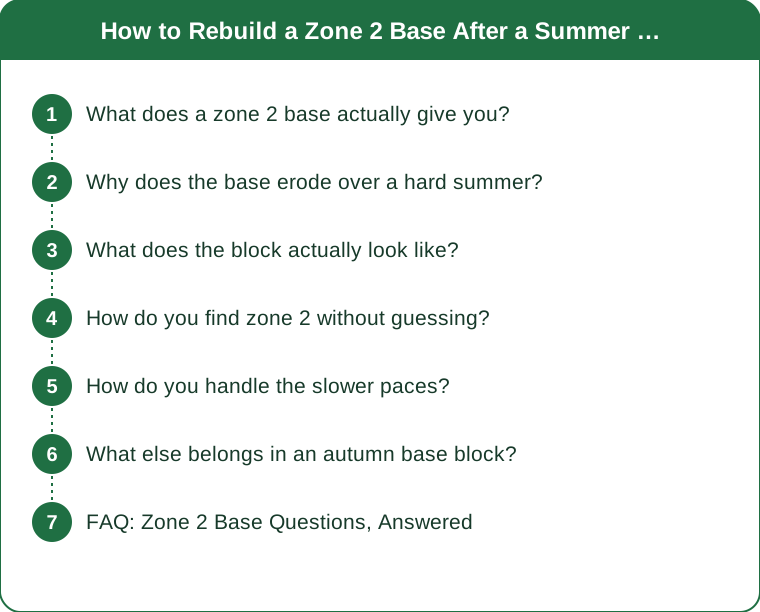
What does a zone 2 base actually give you?
A set of adaptations that only build at low intensity, and that everything else depends on.
Mitochondrial density increases. Low-intensity aerobic work drives the growth of mitochondria in muscle cells, which are where aerobic energy production happens. More mitochondria means more capacity to produce energy aerobically, which means a higher output before you have to rely on anaerobic pathways.
Capillary networks expand. Sustained easy work builds the small blood vessels that deliver oxygen to working muscle. This adaptation appears to respond specifically to volume at low intensity, and it is slow - the timescale is months, not weeks.
Fat oxidation improves. A well-developed aerobic base means burning a higher proportion of fat at a given intensity, which spares glycogen. For anything over an hour or so, this is a large part of what determines whether you fade.
Your heart adapts structurally. Sustained moderate work increases the volume of blood pumped per beat, which lowers heart rate at every intensity and raises your ceiling.
And crucially, these adaptations do not come from hard work. Intervals develop different qualities - they improve your ability to tolerate and clear lactate, they raise your maximum aerobic capacity, they sharpen. What they do not do is build the aerobic base underneath, and a season of them without a base underneath produces exactly the plateau most people hit in their second or third year of training.
Why does the base erode over a hard summer?
Because the training that improves race performance is not the training that maintains the foundation.
Race seasons crowd out easy volume. Between races, taper weeks, recovery weeks, and the hard sessions themselves, the sustained low-intensity work that builds the base gets squeezed to almost nothing.
Easy days stop being easy. This is the central problem in amateur endurance training, and it is remarkably consistent. Fatigue, competitiveness, and training with faster people all push easy runs into a moderate zone - hard enough to accumulate fatigue, easy enough not to produce the adaptations that hard training produces. The dead zone.
Fatigue accumulates and masks the erosion. You are still fit, so you do not notice the foundation shrinking. It shows up as an easy pace that feels harder, a higher heart rate at the same effort, and a longer recovery from the same sessions.
And summer conditions push heart rate up, which makes it genuinely hard to run in zone 2 at all. In heat, your heart rate at any pace is elevated, so anyone training by heart rate through a hot summer either runs absurdly slowly or drifts above the zone. Most people drift.
Which is why autumn is the right time. Cool weather makes zone 2 training dramatically easier - your heart rate at a given pace drops, so the pace at which you can stay in the zone is faster and less demoralizing. The single best month to start an aerobic base block is the first properly cool one.
What does the block actually look like?
Eight to twelve weeks, mostly easy, with a small amount of intensity retained.
Volume distribution: roughly eighty percent easy, twenty percent hard. This distribution appears repeatedly in the training of endurance athletes across sports, and the common amateur error is running something closer to sixty-forty, with most of the forty landing in the moderate dead zone.
Most sessions genuinely easy. Conversational pace, throughout. If you cannot speak in full sentences, you are too fast. This is the whole discipline of the block and it is harder psychologically than any interval session.
One or two quality sessions a week, kept short. Retaining a small amount of intensity preserves your top end and stops the block feeling like a slog. Strides, a short tempo, or some hill sprints - enough to keep the machinery, not enough to compromise the volume.
Build volume gradually. Increasing weekly volume by roughly ten percent, with an easier week every third or fourth week, is a reasonable and conservative approach.
Duration over intensity for the long session. Time on feet is the currency of an aerobic base block, and a longer easy session does more than a shorter harder one.
And commit to the full block. The adaptations are slow. Four weeks is enough to feel worse and not long enough to feel better, which is precisely why so many people abandon it in week five and conclude it does not work.

How do you find zone 2 without guessing?
Several methods, none perfect, and they converge if you use more than one.
The talk test is the most practical. You should be able to hold a conversation in full sentences. If you are breaking sentences to breathe, you are above the zone. It requires no equipment, it works in any conditions, and it is more reliable than most people expect.
Nasal breathing is a stricter version. If you can breathe through your nose comfortably for the whole session, you are almost certainly in the right place. Some people find this uncomfortable regardless of intensity, so treat it as one data point.
Heart rate formulas are a starting point and a rough one. The common estimates for maximum heart rate have a wide error range across individuals, so a zone calculated from one can be well off for you. Use it as a first approximation and adjust based on how the effort actually feels.
A lactate or metabolic test is the accurate option if you have access to one, and it is genuinely useful for people who train seriously. It is not necessary for most people.
Watch for cardiac drift within a session. Heart rate rising steadily at constant pace during a long easy run usually means you started slightly too fast, or that heat and dehydration are contributing. A well-paced zone 2 run should show relatively little drift.
And be aware of what shifts your heart rate. Heat, dehydration, poor sleep, illness, caffeine, and stress all raise it at a given pace. On those days, running by feel keeps you in the right zone while running by pace does not.
A note on the ranges: the specific heart rate numbers vary meaningfully between individuals, and going by effort is more robust than going by a formula. If you want precision, testing is the route.
How do you handle the slower paces?
By reframing what the sessions are for, and by keeping the evidence.
Expect to be slower at first, sometimes considerably. People coming off a hard season frequently find their true zone 2 pace embarrassing relative to what they were running. This is the single most common reason the block gets abandoned.
The pace is not a verdict on your fitness. It is a measure of where your aerobic base is right now, which is precisely the thing you are addressing. A slow easy pace is the diagnosis, not the outcome.
Track pace at a fixed heart rate over the block. This is the measurement that matters and it is enormously motivating. Running at the same heart rate, month over month, and watching the pace improve is direct evidence that the base is building - and it usually starts moving within four to six weeks.
Run alone, or with people who are also running easy. Group runs are where easy days die. This is not a small point.
Use the time. Easy running is the only training where you can genuinely listen to something, think, or have a conversation. Treating the block as pleasant rather than as a sacrifice is what gets people through twelve weeks of it.
And take the ego hit early. The first two or three weeks are the worst. By week six the pace has usually improved noticeably, and by week ten most people are running faster at the same heart rate than they were at the end of the season.
The cool autumn weather helps here more than anything else - your heart rate at any pace drops in cooler air, so the paces you can hold in zone 2 in October are meaningfully faster than what you could hold in August. Some of the improvement people see in the first few weeks of an autumn base block is the weather, and it is a genuine morale advantage regardless.
What else belongs in an autumn base block?
The work that a race season crowds out, which is most of the things that keep you healthy.
Strength training, properly. Autumn is the ideal time for two sessions a week of progressive resistance work. It improves running economy, addresses the imbalances a season builds, and is far easier to fit around easy volume than around hard intervals. This is the single highest-value addition to a base block and it is the most commonly skipped.
Address the niggles now. Every endurance athlete finishes a season with something that has been managed rather than fixed. An easy volume block is exactly the right window to see a physio and deal with it, because there is no race to protect and the training load is forgiving.
Rebuild mobility and range. Seasons of repetitive movement reduce range in predictable places - hips, ankles, thoracic spine. Twenty minutes twice a week during a base block pays off for the whole following year.
Fix the sleep. Race seasons and travel disrupt it, and the aerobic adaptations you are chasing happen during recovery. This is not a soft recommendation - it is where the adaptation actually occurs.
Add cross-training if it helps. Cycling, swimming, and rowing all build aerobic base with less impact, which is useful if your joints have taken a beating. Zone 2 is zone 2 regardless of the modality, and the cardiac and mitochondrial adaptations transfer well even if the sport-specific ones do not.
And plan the year backward from the goal. If your target event is in spring, a base block through autumn and early winter, then a build phase, then a sharpening block, is the standard structure for a reason. Knowing where the block sits in the year makes it much easier to commit to.
This is general training information rather than individual coaching, and if you have a heart condition, are new to exercise, or are managing an injury, get advice from a doctor or a qualified coach before starting a structured block.
FAQ: Zone 2 Base Questions, Answered
How long before I see a difference?
Most people see pace improving at the same heart rate within four to six weeks, with the meaningful structural adaptations building over the full eight to twelve. It is one of the slowest-responding and most durable things you can train.
Will I lose my speed?
You will lose a small amount of sharpness, which returns within a few weeks of reintroducing intensity. Retaining one short quality session a week limits the loss substantially, and the base you build raises the ceiling that the sharpening then works from.
Is walking during a zone 2 run acceptable?
Entirely. If your easy pace requires walking on hills to stay in the zone, walk. Keeping the intensity correct matters far more than running continuously, and this is normal for people early in a base block.
Can I do zone 2 on a bike instead of running?
Yes - the central cardiovascular adaptations transfer well, though the tendon, bone, and running-specific adaptations do not. A mix is often ideal, especially if you are managing impact-related niggles.
How many hours a week do I need?
More is better up to what you can recover from, and consistency matters far more than any specific number. Four to six hours a week done consistently for twelve weeks builds a substantially better base than eight hours done erratically for five.
TL;DR:
- A hard summer builds fitness on an eroding foundation, because mitochondrial density, capillary growth, and fat oxidation only develop from sustained low-intensity volume.
- Run an eight to twelve week block at roughly eighty percent easy and twenty percent hard, keeping one or two short quality sessions to preserve sharpness.
- Use the talk test rather than a formula, expect slow paces at first, and track pace at a fixed heart rate as the real measure of progress.
- Add two strength sessions a week, fix the niggles you managed all season, and cool autumn air makes zone 2 paces meaningfully faster than summer ones.
The dullest block in the training year is the one that decides what next spring is capable of.
Keep Reading
This article is for general informational purposes only and is not medical advice. Always consult a qualified health professional for guidance specific to you.