The Complete Guide to Zone 2 When Your Only Free Hour Is After Work
Quick Answer: Your heart rate at any given pace is typically 5 to 10 beats higher in the evening than in the morning, and sometimes more. Core body temperature peaks in the late afternoon, the day’s accumulated stress raises baseline arousal, residual caffeine is still active, you are warmer and more dehydrated, and you have been on your feet. None of that means you are less fit at 6pm - it means the same effort produces different numbers. Recalibrate zone 2 to the evening rather than fighting the numbers, and use pace or the talk test as the cross-check.
You did the exact same route at the exact same pace on Saturday morning at 128 beats.
Wednesday at six it is 141 and it feels harder, and you have started wondering whether you are getting worse.

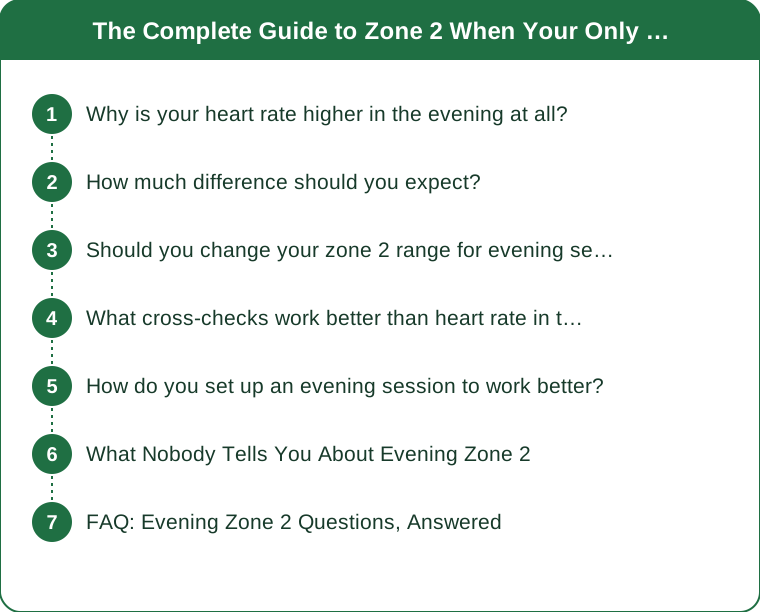
Why is your heart rate higher in the evening at all?
Core body temperature follows a daily rhythm and typically peaks in the late afternoon to early evening, often around half a degree above the morning low. Higher core temperature means the cardiovascular system is already doing thermoregulatory work before you start.
Resting heart rate follows the same curve, running several beats higher in the late afternoon than in the early morning for most people. Your starting point is simply higher.
Accumulated psychological stress raises baseline arousal. A day of meetings, decisions and screen time leaves the sympathetic nervous system more activated than it was at 7am, and that shows up directly in heart rate.
Caffeine is still in the system. With a half-life of roughly five hours, a lunchtime coffee is still meaningfully present at 6pm, and caffeine raises heart rate at a given workload.
Hydration status is usually worse. Most people finish the working day mildly dehydrated, and reduced plasma volume means the heart beats faster to move the same volume of blood.
You have been upright and active all day. Even a desk day involves standing, walking and carrying, and there is a real if small accumulated load in the legs.
Digestion competes for blood flow if you have eaten in the previous couple of hours, and that raises heart rate at any given effort.
And the environment is different. An evening in late August is warmer than an early morning, and heat is the single largest environmental driver of heart rate at a fixed pace.
How much difference should you expect?
Five to ten beats per minute at the same pace is the common range for the circadian component alone, and this is well documented across the day.
Add heat and it goes higher. Training in 26 degrees rather than 16 degrees can add another 5 to 15 beats at the same effort, which is why late-summer evening sessions look worst.
Dehydration adds roughly 3 to 5 beats per percent of body mass lost, and a normal working day easily produces one percent.
A stressful day can add several beats on its own, and this is the component that varies most from day to day and confuses people the most.
Caffeine typically contributes a few beats depending on dose and timing.
Which means 15 to 20 beats of difference between a cool Saturday morning and a hot, stressful Wednesday evening is entirely ordinary and says nothing about fitness.
The individual variation is large. Some people show minimal circadian variation; others show substantially more than the average. Yours is worth measuring rather than assuming.
And the direction is consistent even when the size is not, so once you know your own offset it becomes a reliable adjustment rather than a mystery.
Should you change your zone 2 range for evening sessions?
Effectively yes, though it is better framed as recalibrating rather than as having two zones. The physiological state that constitutes zone 2 is defined by metabolism, not by a number on a watch.
Zone 2 is the intensity at which you are predominantly using fat as fuel and lactate stays roughly at baseline, and that intensity shifts slightly in the heat and with the day’s accumulated state.
If your morning zone 2 ceiling is 135, an evening ceiling around 142 to 145 is a reasonable working adjustment for the same physiological intensity, adjusted by what you actually observe.
Establish your own offset by doing the same route at the same pace morning and evening on two similar days, and take the difference. That number is more useful than any generic formula.
Re-check it seasonally, because the heat component changes substantially between August and November.
Do not simply slow down to hit the morning number, because that pushes you below the intensity where zone 2 adaptations actually occur - which is the most common mistake here.
And keep one reference session at a consistent time of day and consistent conditions, so you have something genuinely comparable to track fitness with over months.
Watch-calculated zones are estimates anyway. Age-based formulas carry substantial error, so treating a displayed zone boundary as exact is misplaced precision to begin with.

What cross-checks work better than heart rate in the evening?
The talk test is the most robust single check. In zone 2 you should be able to speak in full sentences with a slight strain but no gasping, and this holds regardless of time of day, heat or stress.
Nasal breathing is a decent proxy for many people. If you can maintain nose breathing without struggling, you are almost certainly not above zone 2.
Pace at a fixed route is useful in cool conditions but degrades badly in heat, so it works better in October than in August.
Rating of perceived exertion around 3 to 4 out of 10 corresponds well to zone 2 for most people and is not affected by the circadian offset in the way heart rate is.
Breathing rhythm relative to stride is a good learned cue - most people settle into a stable pattern in zone 2 and lose it above.
Power on a bike is the gold standard because it is a direct measure of work output rather than a physiological response, which is exactly why cyclists moved to it.
How you feel two hours later matters too. A genuine zone 2 session leaves you feeling better than when you started; if evenings consistently leave you flattened, the intensity was too high regardless of what the watch said.
And drift within the session is informative - heart rate climbing steadily at constant pace is cardiac drift, and in the evening in summer it arrives sooner.
How do you set up an evening session to work better?
Hydrate through the afternoon rather than just before. A litre in the two hours before does not undo a day of deficit and mostly makes you need a toilet.
Move the last coffee earlier. A cut-off around 2pm removes a meaningful part of the evening heart rate elevation and helps sleep as well.
Warm up longer than you would in the morning, counterintuitively - a stressed, stiff evening body settles into a steady state better with 10 to 15 minutes of easy build rather than 5.
Give yourself 10 minutes of transition before starting. Going straight from a laptop to a session carries the day’s arousal into the first 20 minutes, and a short walk first genuinely lowers the numbers.
Time it at least 90 minutes after a substantial meal so digestion is not competing for blood flow.
Choose the coolest available option in late summer - shaded routes, after sunset, or indoors with a fan - because heat is the largest single controllable factor.
A fan indoors is not optional. Indoor cycling or treadmill work without airflow produces dramatically higher heart rates than the same effort outdoors, and this is the most common cause of a completely unrecognisable indoor zone 2.
And finish at least 90 minutes before bed if you can, since core temperature stays elevated afterwards and that is the mechanism by which late sessions disturb sleep.
What Nobody Tells You About Evening Zone 2
Evening is genuinely the better time to train for most physical measures, and the higher heart rate is unrelated to that. Muscle strength, power output, flexibility and reaction time all peak in the late afternoon to early evening, and perceived exertion at a fixed workload is often lower. The number on the watch is the one thing that looks worse. If your schedule forces evenings, you are not making a compromise on physiology - you are only making one on data comparability.
Consistency of timing beats optimality of timing by a wide margin. Someone who trains at 6pm five days a week will out-adapt someone who trains at the theoretically optimal hour twice a week when their diary allows. The circadian offset also shrinks in practical terms once it is consistent, because you stop having to reinterpret every session.
Your watch’s automatic zone updates can make this worse. Devices that recalculate zones from recent data will drift your zone boundaries upward if most of your sessions are evening ones, then leave you training too hard on the occasional weekend morning. Knowing whether your device does this - and considering fixing the zones manually - is worth ten minutes in the settings.
The stress component is the one worth acting on rather than adjusting for. Temperature and circadian rhythm are fixed. But an evening heart rate that is 15 beats high after a bad day and 6 beats high after a good one is telling you something real about your recovery state. A pattern of consistently very elevated evening sessions is worth reading as accumulated stress rather than as a calibration problem.
Late-summer evenings are the hardest of the whole year for this. Late August retains most of the summer heat but the light is going, so people move sessions earlier into the hottest part of the evening rather than later into the cool. Waiting an extra 45 minutes for the temperature to drop often does more for your numbers than any training adjustment - and by late September the problem largely disappears on its own.
Heart rate variability in the morning is a better fitness signal than any evening session number. If you want to know whether you are actually adapting, morning resting heart rate and HRV trends over weeks tell you far more than comparing Wednesday evening to Saturday morning. Those are measured in a controlled state, which is exactly what evening sessions are not.
And sleep is the real constraint on evening training, not heart rate. Core temperature stays elevated for a while after a session, and finishing too close to bed delays sleep onset for many people. The zone 2 session that costs you 40 minutes of sleep has a poor net return, and finishing 90 minutes before bed is a bigger lever than any of the pacing adjustments above.
FAQ: Evening Zone 2 Questions, Answered
Is evening zone 2 less effective than morning?
No. The adaptations come from time at the right metabolic intensity, not from the clock. Only the heart rate numbers differ.
How do I know if I am actually in zone 2 in the evening?
Use the talk test as the primary check. Full sentences with slight strain and no gasping is zone 2 regardless of what the watch shows.
Should I set two different zone ranges on my watch?
Many people do, and it works. Alternatively use one range and mentally add your measured offset for evening sessions.
Why is it so much worse indoors?
No airflow. Indoor sessions without a fan run substantially higher at the same effort because heat cannot dissipate. A decent fan closes most of the gap.
Does eating before an evening session matter?
Yes. Digestion competes for blood flow and raises heart rate at a given effort. Aim for at least 90 minutes after a substantial meal.
How late is too late?
Finishing more than 90 minutes before bed suits most people. Elevated core temperature after a session is what delays sleep onset.
Should I compare my evening sessions to my morning ones at all?
Only with the offset applied. For tracking fitness over months, keep one consistent reference session at the same time of day in similar conditions.
TL;DR:
- Evening heart rate runs 5 to 10 beats higher at the same pace from circadian rhythm alone, and 15 to 20 with heat, stress and dehydration stacked on.
- That is not a fitness problem, and slowing down to hit the morning number drops you below the intensity zone 2 needs.
- Measure your own offset with the same route morning and evening, and recalibrate rather than fighting the display.
- Use the talk test and perceived exertion as the cross-checks, since neither carries the circadian offset.
- Cut caffeine by 2pm, hydrate through the afternoon, take 10 minutes of transition, and use a fan indoors.
- Finish 90 minutes before bed, and keep one consistent reference session for tracking fitness over months.
Six o’clock you is not a worse athlete than seven a.m. you. Six o’clock you is just warmer, more caffeinated and further into the day.
Keep Reading
This article is for general informational purposes only and is not medical advice. Always consult a qualified health professional for guidance specific to you.