The Complete Guide to Getting Zone 2 Actually Right
Quick Answer: Zone 2 is the intensity where you are working aerobically with minimal lactate accumulation — practically, where you can hold a full conversation but would rather not. Most people train above it because it feels too easy to be useful. The adaptations it produces are mitochondrial density, capillary growth, and improved fat oxidation, and they take 8 to 12 weeks of consistent volume to become noticeable.
Zone 2 has become the most discussed and least correctly executed training concept in endurance fitness. Here is the whole thing, properly.

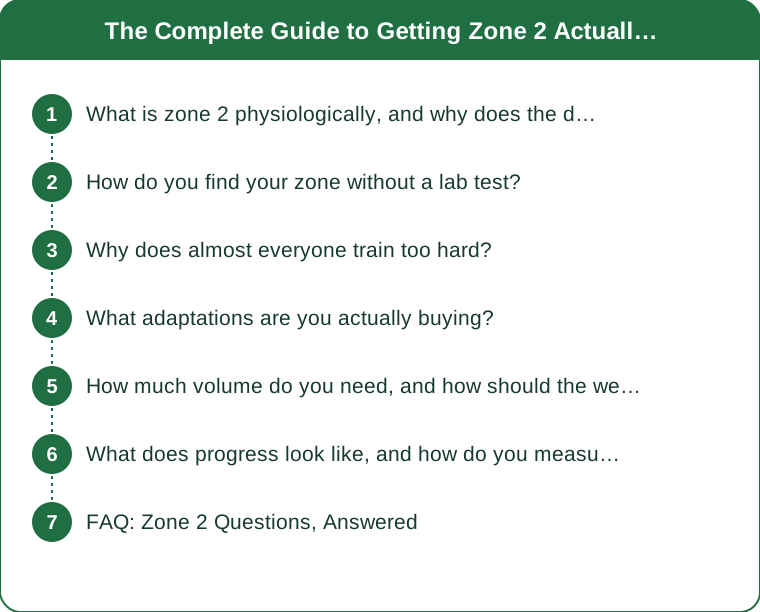
What is zone 2 physiologically, and why does the definition matter?
Zone 2 sits between your first and second lactate thresholds. Below the first threshold, blood lactate stays at resting levels. Above the second, it rises uncontrollably and you are on a clock. Between them, lactate is elevated but stable — your body produces it and clears it at matching rates.
Zone 2 is the upper portion of that stable region, typically corresponding to a blood lactate concentration around 2 mmol/L. This is the highest intensity you can sustain while remaining almost entirely aerobic, which is what makes it valuable — you are maximizing the aerobic stimulus per unit of fatigue.
The definition matters because the popular versions of it are inconsistent. Five-zone models, three-zone models, and percentage-of-max-heart-rate models all use the term differently, and someone following a five-zone model’s zone 2 and someone following a three-zone model’s zone 1 may be training identically.
The most useful practical definition ignores the numbering entirely: zone 2 is the highest intensity at which you could hold a full conversation without needing to break sentences to breathe. If you can speak in complete paragraphs comfortably, you may be slightly below. If you are breaking sentences, you are above.
The reason precision matters here more than in most training is that the adaptations zone 2 produces are intensity-specific. Going 10 percent harder does not give you a better version of the same stimulus — it gives you a different stimulus with a much higher fatigue cost, which is exactly why so many people train hard and plateau.
How do you find your zone without a lab test?
There are four practical methods, in descending order of accuracy.
The first is a lactate test, which requires a meter and finger pricks but is genuinely accessible — consumer lactate meters cost less than a good pair of running shoes. You run at progressively increasing intensities and measure lactate at each step, looking for the point where it settles around 2 mmol/L. This is the only method that measures the thing you are actually trying to find.
The second is the talk test, which correlates surprisingly well with lactate-based zone determination in research. Recite something aloud — a paragraph you know, or count backward from 100 — every ten minutes during a run. If you can complete it comfortably, you are in range. If you need to breathe mid-sentence, back off. Its accuracy is good enough that most people never need anything else.
The third is nasal breathing. If you can breathe entirely through your nose at your current pace, you are almost certainly at or below zone 2 for most people. This method tends to place you slightly too low, but erring low is far less costly than erring high.
The fourth is heart rate, which is the most popular and the least reliable of the four. The common formula — 180 minus your age, adjusted for training status — is a starting estimate, not a measurement. Maximum heart rate varies by 10 to 20 beats between individuals of the same age, and zone boundaries as a percentage of max vary too.
If you use heart rate, use it as a check on the talk test rather than the other way around. Find your zone by conversation, note the heart rate it corresponds to, and then use that number on subsequent runs. That is a personally calibrated heart rate zone rather than a formula-derived one, and it is far more useful.
One complication worth knowing: cardiac drift means your heart rate will climb 5 to 15 beats over an hour at a completely unchanged effort, driven by heat and fluid loss. If you rigidly hold a heart rate ceiling, you will slow progressively through a long session for no physiological reason. Allow the drift.
Why does almost everyone train too hard?
Several reasons, and they compound.
The most basic one is that correct zone 2 feels too easy to be productive. There is a deep intuition that training should be hard to work, and a pace where you could hold a phone conversation violates it. People add 30 seconds per mile because it feels more like exercise, and 30 seconds per mile is often the entire difference between zone 2 and zone 3.
The second is time pressure. Zone 2 adaptations are volume-driven, so a proper session is 45 to 90 minutes. Someone with 30 minutes available will unconsciously raise the intensity to feel like they got something out of it, which converts an easy session into a moderate one.
The third is the group dynamic. Training with others almost always pushes pace upward, and the person who is honest about running easy is usually running alone.
The fourth is terrain. Hills push you out of zone regardless of your intention, and most people do not slow down enough on climbs. On a hilly route, holding zone 2 means walking some climbs, which almost nobody is willing to do and which is precisely the discipline the method requires.
The consequence of training slightly too hard is not that you get a slightly worse version of the benefit. It is that you land in the moderate-intensity zone that produces meaningful fatigue without producing either the aerobic adaptations of true zone 2 or the high-intensity adaptations of proper interval work. This is the classic gray zone, and it is where an enormous number of recreational endurance athletes spend most of their training hours while wondering why they are not improving.

What adaptations are you actually buying?
Four main ones, and understanding them explains why the intensity has to be what it is.
Mitochondrial density is the headline. Mitochondria are where aerobic energy production happens, and low-intensity high-volume training increases both their number and their size in trained muscle. More mitochondria means more capacity to produce energy aerobically, which raises the intensity at which you remain aerobic.
Capillary density is the second. Sustained low-intensity work stimulates growth of the small vessels that deliver oxygen and remove waste at the muscle level. This directly improves your ability to clear lactate, which raises your thresholds.
Fat oxidation capacity is the third and the one most often oversold. Zone 2 training improves your ability to use fat as fuel at a given intensity, which spares glycogen. This matters enormously for events lasting several hours and matters much less for a 5K.
And fourth, stroke volume — the amount of blood your heart moves per beat — improves with sustained submaximal work, which is why resting heart rate tends to fall over a zone 2 block.
Crucially, these adaptations occur in the slow-twitch fibers that zone 2 preferentially recruits. Training harder recruits fast-twitch fibers instead, which means the slow-twitch fibers doing the bulk of your endurance work receive less stimulus, not more. That is the mechanistic reason why going faster gives you a different result rather than a better one.
The timeline: mitochondrial adaptations begin within a few weeks but are not perceptible for 8 to 12. Capillary growth is slower still. Anyone evaluating zone 2 after three weeks is evaluating it before it has had a chance to do anything, which is the most common reason people abandon it.
How much volume do you need, and how should the week look?
The commonly cited target is 150 to 180 minutes a week of zone 2 work as a meaningful dose, split into sessions of 45 to 90 minutes.
Session length matters because the adaptations are partly duration-dependent. Three 20-minute sessions are not equivalent to one 60-minute session, and the general consensus is that sessions below 30 minutes contribute relatively little to the specific adaptations you are after.
The classic structure is polarized: roughly 80 percent of your training time in zone 2 or below, and 20 percent at genuinely high intensity, with as little as possible in between. This distribution shows up consistently in the training logs of elite endurance athletes across sports, and it works for recreational athletes too.
A workable week for someone training four times: two zone 2 sessions of 60 minutes, one longer zone 2 session of 75 to 90 minutes, and one interval session. The interval session should be genuinely hard, which is only possible if the other three were genuinely easy.
Modality matters less than people assume. Cycling, rowing, and incline walking all produce zone 2 adaptations, and cycling has a practical advantage — it is much easier to hold a precise low intensity on a bike than while running, where the mechanics of a very slow run become awkward.
That awkwardness is worth naming directly. Many runners find that true zone 2 requires a pace slow enough that their running form degrades or that they need to walk. If that is you, the honest answer is to do your zone 2 work on a bike, on a rower, or as brisk incline walking, and to run at paces where your mechanics work. Running badly for 60 minutes to hit a heart rate number is not a good trade.
What does progress look like, and how do you measure it?
The primary marker is pace or power at a fixed heart rate. If you can run 9:30 per mile at 135 beats per minute in January and 8:50 per mile at the same heart rate in April, you have improved substantially, and that improvement is exactly what zone 2 training is designed to produce.
Track this deliberately. Pick a fixed route or a fixed indoor setup, do the same session every four weeks under similar conditions, and record pace and average heart rate. Do it at the same time of day, because heart rate varies across the day.
Resting heart rate is a secondary marker and a slower one. A drop of 3 to 8 beats over a training block is common and is a real signal, though it is also affected by sleep, stress, and illness, so read the trend rather than any single morning.
The subjective marker matters too: the pace that felt like the top of your zone should start feeling comfortably mid-zone. When your original zone 2 pace begins to feel genuinely easy, it is time to retest rather than to assume your zone moved on its own.
What is not a good marker: how you feel during a hard session. Zone 2 blocks often produce a period where high-intensity efforts feel flat, particularly if volume increased. That usually resolves as you absorb the block.
A final caution on expectations. Zone 2 improvements are real and they are gradual. Someone who has never trained aerobically may see substantial change in eight weeks; someone with a decade of training may see a small improvement over a six-month block. Both are normal, and the second is not a failure of the method.
FAQ: Zone 2 Questions, Answered
Is walking fast enough to be zone 2?
For many people, especially those newer to training, brisk walking or incline walking sits squarely in zone 2 and is a completely legitimate way to do the work. For well-trained individuals it usually falls below.
Can I do zone 2 in a fasted state?
You can, and some people prefer it. The evidence that fasted training meaningfully enhances fat oxidation adaptations beyond what zone 2 already produces is mixed. If it helps you fit the session in, fine; if it makes you cut the session short, it is counterproductive.
Does strength training interfere with zone 2 adaptations?
No, and the two combine well. Schedule them so that fatigue from one does not compromise the quality of the other — generally lifting after an easy aerobic session rather than before.
How long before I stop feeling like I am wasting my time?
Most people report the mental shift around week six to eight, when the pace-at-heart-rate improvement first becomes visible in their own data. Before that, you are running on trust in the mechanism.
TL;DR:
- Zone 2 is the highest intensity where you can hold a full conversation and lactate stays stable.
- Find it with the talk test, then note the heart rate — do not start from a formula.
- Aim for 150 to 180 minutes a week in sessions of 45 to 90 minutes, with 80 percent of total training easy.
- The adaptations are mitochondrial and capillary, and they take 8 to 12 weeks to show up.
- Measure progress as pace at a fixed heart rate, retested every four weeks.
The hardest part of zone 2 is not physical. It is spending eight weeks doing something that feels too easy, on faith, before the data confirms it worked. Almost everyone who sticks it out finds that it did, and almost everyone who quit at week three concluded it does not work.
Keep Reading
This article is for general informational purposes only and is not medical advice. Always consult a qualified health professional for guidance specific to you.