The Complete Guide to Fitting Zone 2 Around Strength Training
Quick Answer: Zone 2 and strength training coexist well when you separate them properly. The core rules: put at least six hours between a lifting session and a zone 2 session when possible, do the one you care most about first when you cannot separate them, use low-impact modalities like cycling or incline walking on leg days, and keep zone 2 genuinely easy — the interference effect comes almost entirely from intensity, not duration. Three to four hours of weekly zone 2 fits alongside three strength sessions for most people without measurable strength cost.

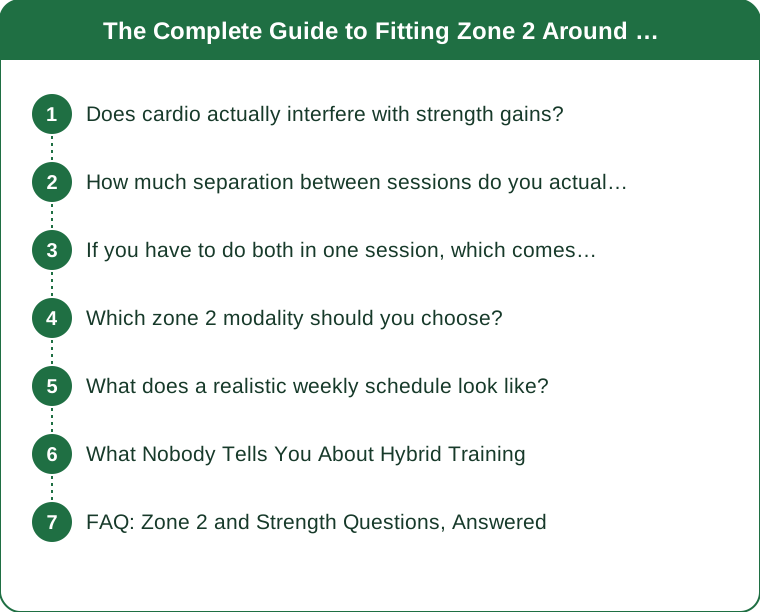
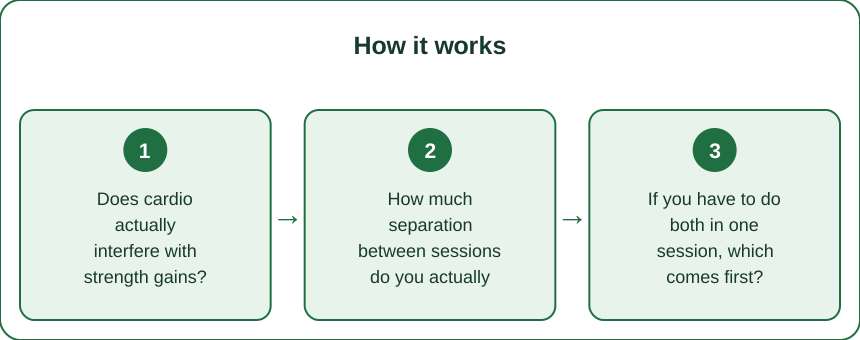
Does cardio actually interfere with strength gains?
Yes, but far less than gym folklore suggests, and the details determine almost everything.
The interference effect is real and reasonably well studied. Concurrent aerobic and resistance training can blunt strength and hypertrophy adaptations compared to resistance training alone. But the magnitude depends heavily on four variables, and zone 2 sits on the favorable side of all four.
Intensity is the big one. High-intensity intervals produce far more interference than steady low-intensity work. Zone 2, by definition, sits below the first ventilatory threshold — conversational, sustainable, roughly 60 to 70 percent of max heart rate. That is the least disruptive form of cardio available.
Modality matters. Running produces more interference with lower-body strength than cycling does, largely because of the eccentric loading and resulting muscle damage. Cycling and incline walking are substantially gentler.
Proximity in time matters. Sessions separated by many hours interfere much less than back-to-back ones.
Total volume matters. Very high aerobic volume — well beyond what most people do — starts to compete for recovery resources regardless of how it is organized.
Put all four in your favor and the interference for a typical recreational lifter doing three to four hours of zone 2 a week is small enough to be difficult to detect. Meanwhile the aerobic benefits — recovery between sets, work capacity across a session, cardiovascular health — actively support the lifting.
How much separation between sessions do you actually need?
Six hours is the practical target, and more is better up to about a full day.
The reasoning is about competing cellular signaling. Resistance training initiates a set of signals promoting muscle protein synthesis; endurance work initiates a partly competing set favoring mitochondrial adaptation. The competition is most acute in the hours immediately after training, and it fades over the following day.
Realistic patterns that work well:
Morning lift, evening zone 2. The most common workable split. Eight to ten hours apart, both sessions get a fed and recovered body.
Zone 2 on non-lifting days. The cleanest option if your schedule allows, and it makes your easy days genuinely easy rather than rest days.
Zone 2 the morning after a lift. Low-intensity aerobic work the day after lifting can actually aid recovery through increased blood flow, provided it stays genuinely easy.
What to avoid where possible: hard leg session followed immediately by 60 minutes of zone 2. Not dangerous, just the least productive arrangement, and the one that produces the fatigue people blame on overtraining.
If you truly cannot separate them, the order rule below matters more than the gap.
If you have to do both in one session, which comes first?
Whichever adaptation you care about more, because the first one gets your best quality.
For most people reading this, that is strength. Lift first, then do zone 2. Pre-fatiguing the legs with 45 minutes of cardio meaningfully reduces the load you can handle and the quality of your movement, and quality is where strength adaptation lives.
There is one exception worth knowing. If your specific goal is aerobic development for an event, do the aerobic work first. The principle is the same — priority goes first — just applied to a different priority.
A few practical notes for combined sessions:
Do not use zone 2 as a warm-up. A warm-up is 8 to 10 minutes. A 45-minute zone 2 block before lifting is a training session, and it will show up in your working sets.
Zone 2 after lifting is easier to keep in zone than you expect, because your heart rate is already elevated. Watch it — you may need to go slower than usual to stay under the ceiling. Going too hard here converts an easy session into a moderate one, which is the interference zone.
Cap combined sessions at about 90 minutes total. Beyond that, quality falls and the last portion contributes little.
Upper body day is the exception to everything. After an upper session you can do a full zone 2 ride with essentially no interference, because the working muscles barely overlap. This is the single most efficient combination available and it is underused.

Which zone 2 modality should you choose?
Choose based on what you lifted, and this is where most people leave value on the table.
Cycling is the default choice for anyone lifting seriously. Almost no eccentric loading, minimal muscle damage, easy to hold a steady heart rate, and it does not add impact to legs that just squatted. The main downside is that heart rate for a given effort runs somewhat lower on a bike than running, so calibrate zones per modality rather than assuming one number.
Incline walking is the most underrated option. A treadmill at 10 to 12 percent grade at 3 mph puts most people squarely in zone 2 with almost no impact, and it is easy to hold precisely. It is also the most compatible with a busy gym since it needs one machine and no skill.
Rowing works but recruits the posterior chain heavily, which conflicts with deadlift and row days. Fine after an upper-body push session, less good after pulling.
Running is the highest-interference option for lower-body strength, and it is also the one many people actually enjoy. If running is your preference, keep it, and put it on the days furthest from heavy lower-body work.
Swimming has almost zero interference with leg strength and is excellent for recovery. Heart rate runs lower in the water, typically 10 to 15 beats below land equivalents, so your zone ceiling needs adjusting downward.
The practical answer for most hybrid schedules: cycling or incline walking on and around leg days, anything you like on upper days.
What does a realistic weekly schedule look like?
Here is a template for three strength sessions and roughly three and a half hours of zone 2, which is a sensible target for general health and performance.
Monday — Lower body strength. Optional 20 minutes easy cycling afterward as a cool-down, kept genuinely easy.
Tuesday — Zone 2, 60 minutes. Any modality; legs are recovering, so cycling or walking is kindest.
Wednesday — Upper body strength, followed by 30 to 45 minutes zone 2 in the same session. This is the highest-efficiency day of the week.
Thursday — Rest, or 30 minutes very easy walking.
Friday — Full body or lower body strength.
Saturday — Zone 2, 60 to 75 minutes. The longest session of the week, ideally outdoors and enjoyable.
Sunday — Rest or easy activity.
That is three strength sessions and about 3.5 hours of zone 2, with no session where hard lifting is immediately preceded by long cardio.
Adjust by priority. If strength is the goal, cut Saturday to 45 minutes. If aerobic base is the goal, extend Saturday and move Friday’s strength to Thursday for more spacing. The structure matters more than the exact numbers, and the structure is: separate hard leg work from long aerobic work, and stack cardio onto upper-body days.
What Nobody Tells You About Hybrid Training
Your zone 2 heart rate ceiling is lower on lifting days. Residual fatigue elevates heart rate at a given workload, sometimes by 5 to 10 beats. If you hold your usual pace, you have drifted out of zone 2 without knowing. Go by heart rate, not pace, on those days.
Cardiac drift makes long sessions creep upward. Over 60 minutes, especially in late-summer heat, heart rate rises at constant effort as plasma volume drops. Plan to reduce pace in the back half rather than fighting to hold it. This is normal physiology, not fading fitness.
Fueling is where most hybrid programs quietly fail. Doing both means more total energy expenditure, and under-eating shows up first as stalled strength — which people then blame on the cardio. If your lifts are drifting down, look at total calories and protein before you cut aerobic work.
Zone 2 improves your lifting in ways that do not show up on a one-rep max. Better recovery between sets, more total volume tolerated in a session, less fade in the final exercises. Those matter more for long-term progress than the peak number does.
Sleep is the actual limiter. Two training modalities need more recovery than one. If you add three hours of zone 2 without adding sleep, something gives, and it is usually the strength side.
The interference effect is often overstated for beginners. In the first year of training, most people improve at both simultaneously with almost no conflict. The trade-offs sharpen as you approach your ceiling in either direction — which is a good problem to have and a long way off for most people.
FAQ: Zone 2 and Strength Questions, Answered
How much zone 2 is too much alongside lifting?
For most recreational lifters, up to about four to five hours a week is well tolerated. Beyond that, recovery demands start competing noticeably unless sleep and nutrition scale with it.
Can I do zone 2 on rest days, or does that defeat the purpose?
Easy aerobic work on rest days is generally beneficial rather than harmful — it increases blood flow and does not create meaningful additional fatigue when it stays genuinely easy. The mistake is letting a rest-day session drift into moderate intensity, which is the worst of both worlds.
Should I eat differently on combined days?
Eat more, particularly carbohydrate, on days with both. Under-fueling a combined day is the most common cause of the flat, heavy feeling people get in the following session.
Does zone 2 hurt muscle growth specifically?
Less than it hurts maximal strength expression, and in low-impact modalities the effect on hypertrophy is small. Cycling and walking are far more compatible with muscle growth than running is.
How do I know I am actually in zone 2?
The talk test remains the most reliable field method: you should be able to speak in full sentences but not comfortably hold a long conversation. If you are gasping between words, you are above it, and above it is where the interference lives.
What if I only have four days a week total?
Two strength sessions and two zone 2 sessions, fully separated by day, is a genuinely good program. Separation solves most of the problem for free.
This is general information, not medical advice.
TL;DR:
- Interference is real but small at zone 2 intensity — intensity, not duration, drives it.
- Separate sessions by at least six hours where possible; a full day is better.
- If combining, lift first unless aerobic development is your actual priority, and never use a 45-minute ride as a warm-up.
- Choose cycling or incline walking around leg days; stack cardio onto upper-body days, which is the most efficient combination available.
- Expect a 5 to 10 beat higher heart rate on lifting days, and fuel and sleep for two disciplines rather than one.
The hybrid athlete’s real enemy is not cardio. It is doing cardio too hard, too close to lifting, on the wrong day, and then under-eating. Fix the scheduling and both sides improve at once.
Keep Reading
This article is for general informational purposes only and is not medical advice. Always consult a qualified health professional for guidance specific to you.