Why Your Heart Rate Climbs Out of Zone 2 Mid-Workout Even at the Same Pace (Full Explanation)
Quick Answer: Heart rate climbing during a zone 2 session at a constant pace — a phenomenon called cardiac drift — happens primarily because of rising core body temperature and gradual fluid loss through sweat, both of which force the heart to work harder to maintain the same blood flow and cooling demand even though the external workload hasn’t changed, and understanding this mechanism is what separates a well-managed zone 2 session from one that quietly turns into zone 3 without the athlete realizing it.
Many zone 2 training guides mention staying at a target heart rate without explaining why that heart rate naturally creeps upward over a long session, leaving athletes confused about whether to slow down, and if so, by how much.

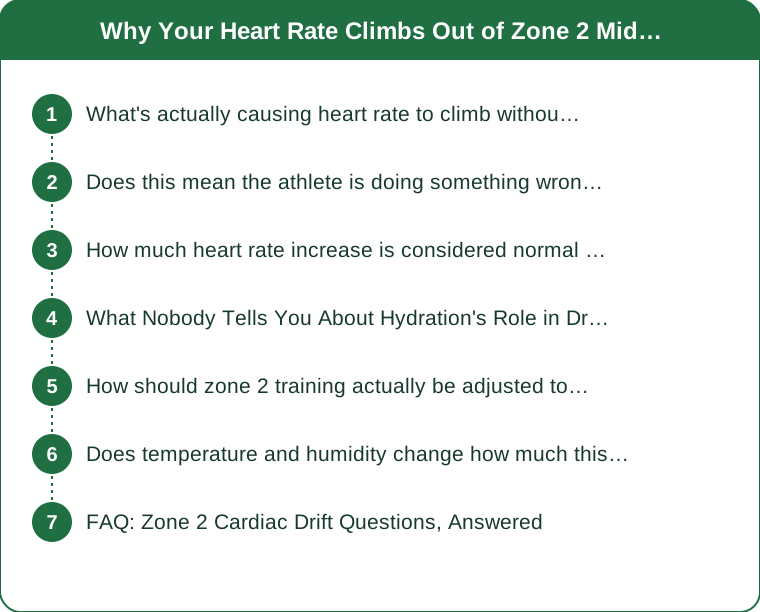
What’s actually causing heart rate to climb without any pace change?
Cardiac drift results primarily from two compounding physiological demands: rising core body temperature requiring increased blood flow to the skin for cooling, and gradually decreasing blood plasma volume from sweat loss, which means the heart has to pump more frequently to circulate the same effective blood volume. Both effects accumulate over the duration of a session, which is why drift becomes more pronounced in the second half of a longer workout than the first.
Does this mean the athlete is doing something wrong if drift happens?
No — cardiac drift is a normal, well-documented physiological response, not a training or pacing error. It happens to well-trained and untrained athletes alike, though the degree of drift varies based on fitness level, heat, humidity, and hydration status; a well-conditioned athlete in cool, controlled conditions will still see some drift, just typically less than someone less trained in hot, humid conditions.
How much heart rate increase is considered normal drift versus a sign to actually slow down?
A gradual increase of roughly 5-10 beats per minute over an hour at a constant pace is commonly considered within normal drift range, while a sharper, faster rise — especially combined with a genuine sense of increased effort, not just a higher number — suggests the pace should actually be adjusted downward to stay in the intended training zone, rather than accepting the drift as purely environmental.

What Nobody Tells You About Hydration’s Role in Drift
Starting a session already mildly dehydrated accelerates cardiac drift meaningfully compared to starting well-hydrated, since the plasma volume decline that drives part of the drift mechanism starts from a lower baseline — proper pre-session hydration is one of the more controllable levers for reducing drift’s practical impact on a training session, even though drift itself can’t be eliminated entirely.
How should zone 2 training actually be adjusted to manage drift in practice?
The most practical approach is allowing a slight pace reduction over the course of a long session specifically to keep heart rate within the target zone, rather than holding a rigid, unchanging pace regardless of what heart rate does — this means a well-executed zone 2 long session often has a slightly negative pace profile (faster early, slightly slower late) purely to compensate for drift, which is a normal and expected pacing adjustment rather than a sign of fading fitness.
Does temperature and humidity change how much this matters?
Significantly — hot, humid conditions accelerate both the core temperature rise and sweat-driven plasma volume decline that drive cardiac drift, meaning the same planned pace may require considerably more downward adjustment on a hot day than on a cool one to stay within the same target heart rate zone, which is part of why zone 2 pace targets are better set relative to heart rate than to a fixed pace number across different weather conditions.
FAQ: Zone 2 Cardiac Drift Questions, Answered
Does cardiac drift happen during shorter, 20-30 minute zone 2 sessions too?
It’s present but generally much less pronounced over shorter durations, since both the temperature rise and fluid loss mechanisms need more accumulated time to meaningfully affect heart rate.
Can better fitness level reduce cardiac drift over time?
Yes, to a degree — improved cardiovascular efficiency and heat adaptation from consistent training can reduce the magnitude of drift somewhat, though it doesn’t eliminate the underlying physiological mechanism entirely.
Should zone 2 training be paused entirely on very hot or humid days?
Not necessarily paused, but adjusting the target pace downward more aggressively from the start, along with increased hydration focus, helps keep the session in the intended zone despite more significant environmental drift.
TL;DR:
- Cardiac drift comes from rising core temperature and declining plasma volume, not a pacing mistake
- A gradual 5-10 BPM rise per hour at constant pace is generally normal; a sharp rise suggests slowing down
- Starting well-hydrated meaningfully reduces the practical impact of drift on a session
- A slightly negative pace profile (faster early, slower late) is a normal, expected way to manage drift
- Hot, humid conditions accelerate drift considerably more than cool conditions at the same effort
Plan zone 2 sessions around heart rate response, not a fixed pace number, and treat mid-session slowdowns as smart pacing, not fading fitness.
Keep Reading
This article is for general informational purposes only and is not medical advice. Always consult a qualified health professional for guidance specific to you.