Why Your Zone 2 Pace Stopped Improving After a Few Months (And What Actually Fixes It)
Quick Answer: A zone 2 plateau after 2-3 months is almost always caused by one of three things: training volume that never actually increased, an aerobic zone that’s crept upward with fitness but was never recalibrated, or insufficient recovery masking real progress. Fixing it usually means adjusting one of those three, not adding intensity.
The first two months of zone 2 training feel almost magical — your pace at the same heart rate improves week over week, and the whole ‘go slow to go fast’ idea finally clicks. Then, without any obvious reason, the improvement just stops. Your heart rate at a given pace stalls, or your pace at a given heart rate refuses to budge no matter how consistent you stay. This is one of the most common frustrations reported by people several months into a structured zone 2 approach, and it has a handful of specific, identifiable causes — not a mysterious plateau you just have to accept.

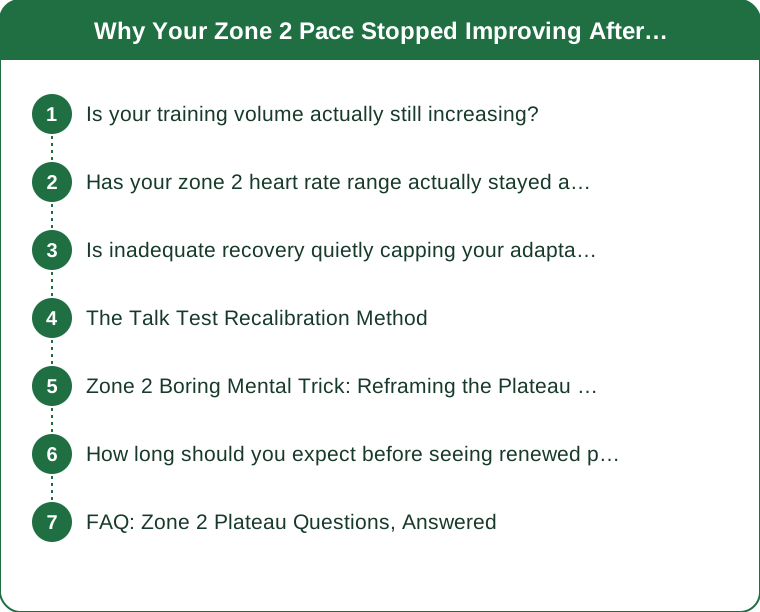
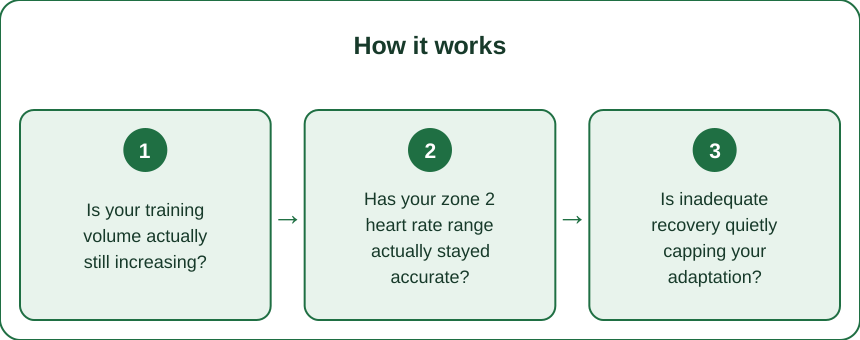
Is your training volume actually still increasing?
The single most common cause of a zone 2 plateau is deceptively simple: total weekly aerobic volume stopped increasing, even though the person assumed it was still progressing because they were ‘staying consistent.’ Consistency at a fixed volume produces adaptation up to a point, and then the body has no new stimulus to respond to.
Aerobic base building follows a dose-response relationship — more consistent low-intensity volume, within reason, continues to drive mitochondrial density and capillary growth for months, sometimes years, in a way that intensity work simply doesn’t replicate. If your weekly zone 2 minutes have plateaued at, say, 150 minutes for the last six weeks, that’s very likely the real story behind your pace plateau, not some deeper physiological ceiling.
The fix here isn’t dramatic — a gradual 10% increase in weekly volume every 2-3 weeks, following standard progressive overload principles, is usually enough to restart visible improvement within a month. The mistake most people make is increasing volume in large, irregular jumps and then getting discouraged when fatigue (not fitness) shows up in their next few sessions.
Has your zone 2 heart rate range actually stayed accurate?
As aerobic fitness improves, your true zone 2 ceiling often drifts upward — but most people set their heart rate zones once, using a formula or a single lactate or talk-test session, and never revisit it. Training at a heart rate range that was accurate three months ago but is now conservative for your current fitness level means you’re training at what used to be zone 2 but functions more like zone 1 for your current body.
This matters because the training effect at true zone 2 versus a now-too-easy zone 1 is meaningfully different — you’re still building an aerobic base, but at a lower relative intensity than intended, which slows the rate of adaptation without making the sessions feel any different day to day. This is a subtle trap precisely because nothing feels wrong; it just quietly under-delivers.
Re-testing your zone 2 ceiling every 6-8 weeks — via a fresh talk test, a lab retest, or a simple aerobic threshold field test — catches this drift before it stalls progress for months. Most people are surprised to find their real zone 2 ceiling has moved up by 5-10 beats per minute since they last checked.
Is inadequate recovery quietly capping your adaptation?
Zone 2 training has a reputation as ‘easy,’ which leads a lot of people to stack it on top of an already demanding schedule — full-time work, other training, poor sleep — without factoring in that aerobic adaptation itself requires adequate recovery to consolidate, just like strength training does.
Chronic under-recovery, especially inadequate sleep (under 7 hours consistently) or accumulated life stress, elevates baseline cortisol and can suppress the very adaptations zone 2 training is trying to build, even while the training itself stays technically easy in the moment. This is a genuinely underappreciated cause of plateaus because the workouts themselves don’t feel hard enough to explain the lack of progress.
If your sleep, stress, or overall training load has crept up over the same months your zone 2 pace plateaued, that correlation is worth taking seriously. A deliberate recovery-focused week — prioritizing sleep, reducing other training stress, and keeping zone 2 volume steady rather than cutting it — often reveals whether recovery, not the zone 2 protocol itself, was the limiting factor.

The Talk Test Recalibration Method
One of the most reliable, low-cost ways to catch and fix zone 2 drift is a simple recalibration protocol: run or ride at a heart rate 5 beats above your current zone 2 ceiling for 10 minutes, and check whether you can still hold a full conversation in complete sentences without gasping.
If you can comfortably talk in full sentences at that slightly higher heart rate, your true zone 2 ceiling has likely moved up and your current range is now too conservative. If you’re gasping for air by sentence three, your original range is probably still accurate and the plateau has another cause.
Repeat this test every 6-8 weeks as a standing check-in, rather than assuming your original zone calculation stays valid indefinitely. This single habit resolves a meaningful share of reported zone 2 plateaus, because it directly targets the most common silent cause — a zone that quietly became outdated as fitness improved underneath it.
Zone 2 Boring Mental Trick: Reframing the Plateau as Data, Not Failure
Part of what makes a zone 2 plateau feel discouraging is the framing — treating a stalled number as a failure of the method, rather than as information about what to adjust next. Athletes who stick with zone 2 training long-term tend to treat a plateau as a diagnostic signal: it’s telling you specifically which variable (volume, zone accuracy, or recovery) needs attention, not that the approach has stopped working.
This reframe matters practically because the two common bad reactions to a plateau — either quitting zone 2 training for higher-intensity work, or grinding through more of the exact same unchanged routine — both skip the actual diagnostic step. A period of genuinely boring, unglamorous troubleshooting (checking volume trends, re-testing your zone, auditing sleep) resolves most plateaus faster than any workout change would.
How long should you expect before seeing renewed progress?
Once you’ve identified and adjusted the actual limiting factor — increased volume, recalibrated zone, or improved recovery — most people see measurable pace improvement at the same heart rate within 3-6 weeks, consistent with typical aerobic adaptation timelines documented in endurance training research.
If you’ve made a genuine adjustment and see zero movement after 6-8 weeks, that’s a reasonable point to consider other less common factors: unaddressed iron deficiency, an underlying health issue affecting cardiovascular efficiency, or a heart rate monitor accuracy problem (chest straps are generally more reliable than wrist-based optical sensors for this kind of precise, longitudinal tracking). This is general information, not medical advice, and persistent unexplained plateaus alongside fatigue are worth discussing with a doctor.
FAQ: Zone 2 Plateau Questions, Answered
Should I add intensity work to break through a zone 2 plateau?
Not as a first move — most plateaus resolve through volume, zone accuracy, or recovery adjustments; adding intensity addresses a different training question and can interfere with the aerobic adaptation zone 2 is specifically building.
How much should I increase weekly zone 2 volume to restart progress?
A gradual 10% increase every 2-3 weeks is a widely used, sustainable guideline — larger jumps tend to produce fatigue that masks rather than accelerates progress.
Is it normal for zone 2 plateaus to happen more than once?
Yes — most consistent zone 2 trainees report periodic plateaus every few months as their fitness improves faster than their zone calibration, making the recalibration habit an ongoing practice rather than a one-time fix.
TL;DR:
- Most zone 2 plateaus trace back to stalled volume, an outdated heart rate zone, or under-recovery
- Re-test your zone 2 ceiling every 6-8 weeks using a simple talk-test protocol
- Increase weekly volume gradually (about 10% every 2-3 weeks) rather than in large jumps
- Treat a plateau as diagnostic data, not a sign the method has stopped working
- Expect 3-6 weeks after a real adjustment before pace improvement shows up again
A stalled zone 2 pace usually isn’t your aerobic system giving up — it’s one specific, identifiable variable that quietly stopped moving while everything else stayed the same.
Keep Reading
This article is for general informational purposes only and is not medical advice. Always consult a qualified health professional for guidance specific to you.