Why Your Zone 2 Pace Stopped Improving (and What Actually Moves It Again)
Quick Answer: A stalled zone 2 pace most often comes from insufficient training volume, inconsistent heart rate zone discipline (drifting into zone 3 without realizing it), or simply needing more time — aerobic base adaptations are famously slow and can take three to six months to show measurable pace improvement at the same heart rate.

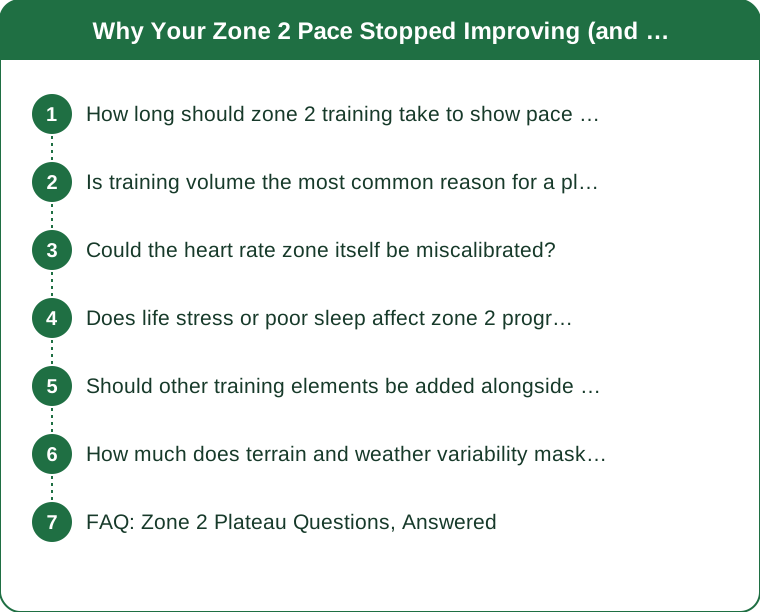
How long should zone 2 training take to show pace improvement?
Aerobic base adaptations happen at the mitochondrial and capillary level, which is a genuinely slow physiological process compared to the relatively fast adaptations seen in high-intensity interval training. Most well-documented case studies and coaching literature suggest three to six months of consistent zone 2 volume before a clear, repeatable pace improvement at the same heart rate becomes evident — expecting weekly progress is one of the most common sources of premature frustration.
Is training volume the most common reason for a plateau?
Often, yes — many people plateau simply because their weekly zone 2 volume is too low to drive continued adaptation, not because of any flaw in the approach itself. Someone doing two 30-minute zone 2 sessions a week is training an aerobic system far less than someone doing four to five sessions of 45-60 minutes, and the plateau in the first case often resolves simply by adding volume rather than changing anything else about the approach.
Could the heart rate zone itself be miscalibrated?
This is a frequently overlooked cause — an inaccurate zone 2 ceiling, set too high from an outdated max heart rate formula, means training is actually happening in zone 3 without realizing it. True zone 2 should feel conversational and sustainable for hours; if sessions consistently feel moderately hard rather than easy, a proper lactate threshold or field test to recalibrate zones is worth doing before assuming the training method itself has stopped working.

Does life stress or poor sleep affect zone 2 progress specifically?
Yes, more than many people expect — heart rate at a given pace is influenced by autonomic nervous system state, and chronic stress or inadequate sleep keeps resting and exercise heart rate elevated independent of actual fitness level. Someone under significant life stress can see their zone 2 pace stagnate or even regress temporarily for reasons that have nothing to do with training volume or method, and addressing recovery factors sometimes unlocks progress that more training volume alone wouldn’t.
Should other training elements be added alongside zone 2 to break a plateau?
A small amount of higher-intensity work — even one weekly threshold or interval session — can improve zone 2 pace indirectly by raising overall aerobic capacity, which shifts the entire heart rate-to-pace curve favorably. This isn’t a contradiction of zone 2 training’s purpose; most structured aerobic base programs include a minority of higher-intensity work specifically because it complements rather than competes with base-building.
How much does terrain and weather variability mask real progress?
Considerably more than most trackers account for — running the same ‘easy pace’ on a hot, humid day or a hilly route produces a notably higher heart rate than a cool, flat day, purely from environmental cardiovascular load, independent of fitness. Comparing zone 2 pace across wildly different conditions rather than similar routes and weather is one of the more common reasons athletes believe they’ve plateaued when the comparison itself is flawed.
FAQ: Zone 2 Plateau Questions, Answered
Is it normal for zone 2 pace to fluctuate week to week even without a true plateau?
Yes — daily variation from sleep, stress, heat, and hydration is completely normal, which is why tracking pace trends over several weeks matters more than comparing any two individual sessions.
Should heart rate zones be retested periodically?
Retesting every eight to twelve weeks, or after a noticeable fitness or life change, keeps zones accurate as fitness improves and prevents training in the wrong zone without realizing it.
Does adding strength training help break a zone 2 plateau?
Indirectly, yes — general strength and running economy improvements from strength work can modestly improve pace at a given heart rate over time, though the effect is smaller and slower than direct aerobic volume increases.
TL;DR:
- Aerobic base adaptations are genuinely slow — three to six months is a realistic timeline before expecting clear pace improvement
- Insufficient weekly training volume is the most common actual cause of a plateau
- Heart rate zones set too high can mean training is happening in zone 3 without realizing it
- Stress, sleep, terrain, and weather all meaningfully affect zone 2 pace independent of true fitness
A stalled zone 2 pace is rarely a sign the method has failed — it’s usually one of a few specific, fixable variables, or simply more patience than the plan initially accounted for.
Keep Reading
This article is for general informational purposes only and is not medical advice. Always consult a qualified health professional for guidance specific to you.