Zone 2 After Being Sick: The Complete Return-to-Training Guide
Quick Answer: Return to training after illness with the neck check as your first filter, then rebuild through a graded progression: two days of walking, then easy zone 2 at reduced duration, then full zone 2, before any intensity returns. Expect elevated heart rate at your normal pace for one to two weeks - that’s normal and it’s the signal to keep pacing by effort rather than by watch. Any chest symptoms, unusual breathlessness, or heart symptoms mean see a doctor before training at all.

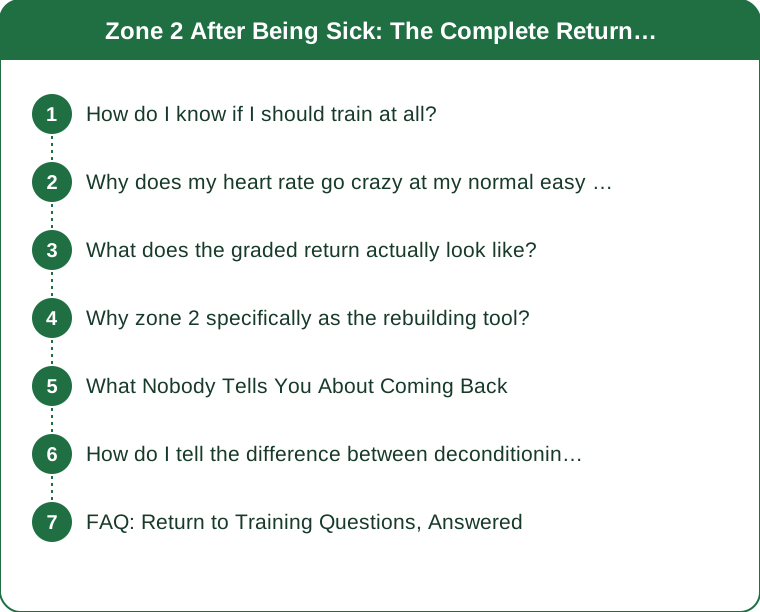
How do I know if I should train at all?
The most widely used rule of thumb is the neck check, and it’s a reasonable first filter for common minor illness.
Symptoms above the neck - runny nose, mild sore throat, sneezing, mild congestion - with no fever, generally mean light exercise is acceptable and unlikely to prolong illness. Many people find easy movement genuinely helps.
Symptoms below the neck - chest congestion, productive cough, body aches, stomach upset - or any fever mean no training. This isn’t a toughness question. Exercising with a fever raises core temperature further and increases cardiovascular strain at exactly the wrong moment.
The neck check is a filter, not a diagnosis. It doesn’t cover everything, and it assumes an ordinary respiratory infection.
Absolute stop signs - see a doctor before training: chest pain or tightness, breathlessness out of proportion to your effort, palpitations or an irregular heartbeat, dizziness or fainting, swelling in the legs, or fatigue that’s dramatically out of proportion to the illness you had. Certain viral infections can affect heart muscle, and the consequences of training through that are serious. This is general information, not medical advice - if anything on that list applies, the answer is a doctor, not a training plan.
Why does my heart rate go crazy at my normal easy pace?
This is the most common and most confusing part of returning, and it has a clear physiological explanation.
After illness, several things elevate heart rate at a given workload:
Reduced plasma volume. Fever, sweating, and reduced fluid intake during illness lower blood volume. Less blood volume means less stroke volume per beat, so your heart compensates with more beats per minute for the same output. This alone can raise heart rate 10-15 bpm at a fixed pace.
Elevated resting heart rate. Immune activity itself raises resting heart rate, often by 5-10 bpm, and it stays elevated for days after symptoms clear.
Reduced cardiac efficiency from detraining. Even five days off produces small measurable declines in cardiovascular fitness.
Residual inflammation. Systemic inflammation raises heart rate independently of everything above.
The practical consequence is enormous for zone 2 specifically: your heart rate zones are temporarily wrong. If you train to your normal zone 2 heart rate ceiling, you’ll be running much slower than usual and still feel like you’re working harder than zone 2 should feel. If you train to your normal pace, your heart rate will be well into zone 3 and you’ll be doing a completely different workout than the one you intended.
The resolution: during the return period, pace by effort and the talk test, not by heart rate. If you can hold a full conversation in complete sentences, you’re in zone 2, regardless of what the watch says. Return to heart rate-based pacing once your resting heart rate has been back to baseline for three consecutive days.
What does the graded return actually look like?
A structure that works for a typical uncomplicated upper respiratory infection lasting three to seven days. Scale the timeline up for longer or more severe illness.
Stage 0 - symptom-free rest, minimum 1-2 days. Wait until you’ve had at least 24 hours with no fever and clearly improving symptoms before doing anything. For a full week of illness, take two days.
Stage 1 - walking only, 2 days. 20-30 minutes of easy walking. The goal is movement, circulation, and an honest readout of how you feel. If a 25-minute walk leaves you wiped out, you are not ready for stage 2, and that information is worth having before you find out on a run.
Stage 2 - easy zone 2, half duration, 2-3 sessions. Your normal zone 2 activity at conversational effort, but 50% of your usual duration. If your normal easy session is 60 minutes, do 30. Stop if effort climbs during the session at a constant pace - that’s a clear signal to end it.
Stage 3 - easy zone 2, three-quarter duration, 2-3 sessions. Same effort, 75% duration. By the end of this stage, most people find their heart rate at a given pace has dropped noticeably toward normal.
Stage 4 - full-duration zone 2, 3-4 sessions. Back to your usual easy volume, still all zone 2, no intensity.
Stage 5 - reintroduce intensity, one session. A single moderate interval session, roughly 70% of your usual volume of hard work. If that goes well, resume normal programming.
A useful heuristic for total timeline: allow roughly one day of graded return per day you were ill. A three-day cold, three or four days back to normal. A week of flu, a week or more.

Why zone 2 specifically as the rebuilding tool?
Zone 2 is uniquely suited to post-illness return for three reasons.
It’s the lowest-stress way to accumulate training volume. Low-intensity aerobic work has a much smaller impact on your immune and stress systems than intense work. High-intensity training produces a temporary period of reduced immune function, which is the last thing you want when you’ve just been sick and are still susceptible.
It’s self-limiting via the talk test. You have a built-in, watch-independent gauge. When your heart rate data is unreliable - which it is for the first one to two weeks - the talk test still works perfectly.
It rebuilds the specific things illness took. Plasma volume restoration responds well to regular moderate aerobic work. Mitochondrial function and aerobic enzyme activity, which decline slightly with any layoff, are precisely what zone 2 targets.
The common alternative - jumping back into a normal week including intervals - fails on all three counts, which is why so many people report getting sick again two weeks after returning. That second illness is often a real consequence of resuming intensity too early, not bad luck.
What Nobody Tells You About Coming Back
Your first good session lies to you. Around stage 3, most people have a session that feels genuinely great - relief after a bad stretch produces real enthusiasm. That’s the session where people skip to stage 5. Don’t. Feeling good on one easy run isn’t evidence your immune system has fully recovered.
Sleep is the better readiness signal than heart rate. Resting heart rate is useful, but sleep quality returning to normal tends to track overall recovery more reliably. If you’re still waking at 3am or sleeping ten hours, you’re not done.
Fitness loss over a week is smaller than it feels. Measurable cardiovascular decline over 7-10 days off is real but modest - typically a few percent. Most of the awfulness of the first sessions back is plasma volume and residual inflammation, both of which resolve in days once you’re moving. You have not lost your fitness.
Antibiotics don’t change the timeline much. People often assume that starting antibiotics means they can train. The infection is still being fought and the systemic load is still there - follow the same graded progression.
Autumn is peak season for this. Late summer into fall is when respiratory infections start circulating in earnest, and it coincides with the start of many training blocks. A conservative return in September protects the whole block; an aggressive one costs you October too.
Track it, because you’ll forget. Write down resting heart rate each morning and one line about how a session felt. Three illnesses from now you’ll have real personal data on your own return timeline, which is far more useful than any general guideline.
How do I tell the difference between deconditioning and something wrong?
This distinction matters more than anything else in this guide.
Normal post-illness deconditioning looks like: elevated heart rate at your usual pace, legs feeling heavy, an easy pace feeling moderately hard, quicker fatigue - all of which improve session over session across one to two weeks.
Signals to stop and see a doctor: breathlessness that’s out of proportion to your effort, chest tightness or pain at any intensity, palpitations or an irregular pulse, dizziness, unusual swelling, or symptoms that get worse rather than better across successive sessions.
The single most useful discriminator is the trajectory. Deconditioning improves. Something requiring medical attention typically doesn’t, or worsens.
A second useful discriminator: deconditioning affects your performance but not your daily life. If climbing a flight of stairs is now hard, that’s not a training issue.
This is general information, not medical advice. Post-viral complications affecting the heart are uncommon but genuinely serious, and the cost of an unnecessary doctor’s visit is far lower than the cost of training through one. If you’re unsure, that uncertainty itself is a reason to ask.
FAQ: Return to Training Questions, Answered
Can I do zone 2 while I still have a mild cold?
With above-the-neck symptoms only and no fever, light zone 2 at reduced duration is generally considered acceptable. Keep it genuinely easy and stop if you feel worse during it.
How long until my heart rate zones are accurate again?
Usually one to two weeks for an ordinary infection. Use resting heart rate returning to baseline for three consecutive days as your marker.
Should I take more days off than I think I need?
Almost always yes. The downside of two extra easy days is negligible; the downside of two extra hard days too early can be weeks.
What if I have a race coming up?
A graded return still beats a rushed one - arriving at a race under-recovered performs worse than arriving slightly under-trained. Talk to a coach or doctor if the timeline is tight.
Does this apply to stomach bugs too?
The same graded structure applies, with extra attention to rehydration and electrolytes before you start stage 1. Fluid deficit after a GI illness is often substantial and makes the first sessions back unnecessarily miserable.
TL;DR:
- Use the neck check as a first filter; any fever or below-the-neck symptoms mean no training
- Chest pain, unusual breathlessness, palpitations, or dizziness mean see a doctor before training at all
- Expect heart rate 10-15 bpm high at your usual pace for one to two weeks - pace by the talk test, not the watch
- Graded return: walking, then half-duration zone 2, then three-quarters, then full, then intensity
- Allow roughly one day of graded return per day you were ill
- The distinguishing signal is trajectory - deconditioning improves session over session, problems don’t
A week of illness costs you very little fitness. Coming back wrong is what costs you the month.
Keep Reading
This article is for general informational purposes only and is not medical advice. Always consult a qualified health professional for guidance specific to you.