Caffeine and Zone 2: Why Your Heart Rate Says You Are Working Harder Than You Are
Quick Answer: Caffeine typically raises heart rate by 3 to 10 beats per minute during submaximal exercise, which is enough to push a genuinely easy effort into what your watch calls zone 3. It does not mean you are working harder - perceived effort actually drops - which is precisely why the number and the feeling disagree. Do not chase the number down by slowing to a crawl. Instead, use the talk test and breathing as your primary check, keep your caffeine habit consistent before easy sessions, and recalibrate your zones under the conditions you actually train in.
Here is the full picture of what shifts your heart rate and how to train around it.

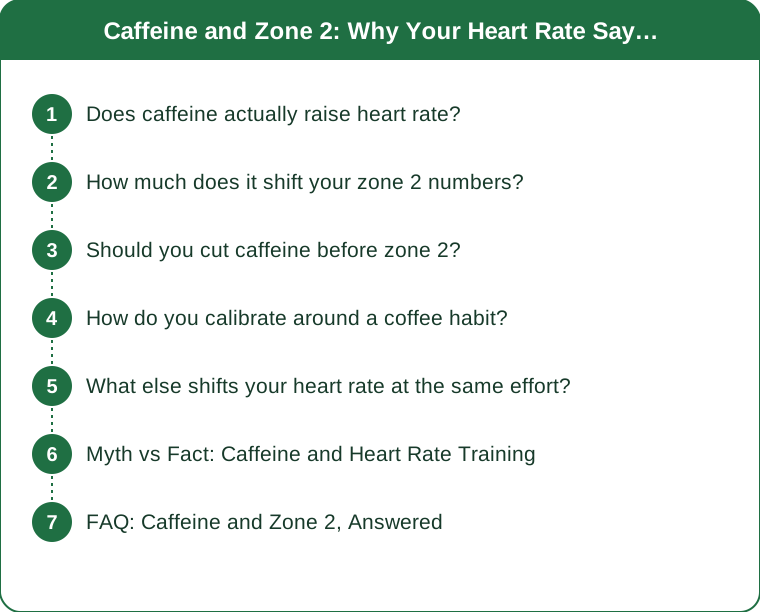
Does caffeine actually raise heart rate?
Yes, though the size of the effect is commonly overstated. At rest, caffeine can raise heart rate slightly or in some cases lower it marginally through a reflex response to increased blood pressure. During exercise, the picture is clearer.
During submaximal exercise, expect roughly 3 to 10 beats per minute higher at the same workload. That is a modest shift in absolute terms and a significant one when your zone 2 band is only 15 to 20 beats wide.
Caffeine stimulates catecholamine release - adrenaline and noradrenaline - which raises heart rate, mobilises fat for fuel, and increases alertness. The heart rate rise is a side effect of the mechanism, not evidence of extra work.
Perceived effort moves the other way. Caffeine reliably reduces how hard a given effort feels, which is why it is one of the best-evidenced performance aids available. So the number goes up while the feeling goes down.
Dose matters substantially. Around 3 mg per kilogram of body weight is the commonly studied performance dose - roughly 200 mg for a 70 kg person, or about two standard coffees. Larger doses raise heart rate more without improving the training.
Tolerance blunts it over weeks. Habitual drinkers show a reduced cardiovascular response compared with people who rarely consume it, which is why a daily coffee drinker may see almost no shift while an occasional one sees a clear jump.
And timing shapes the curve. Caffeine peaks roughly 30 to 60 minutes after consumption with a half-life of about 5 hours, so a pre-run coffee has its largest effect during exactly the first half of your session.
How much does it shift your zone 2 numbers?
It shifts the reading, not the physiology. Your actual metabolic zone 2 - the intensity where lactate stays low and fat oxidation is high - has not moved. What has changed is the heart rate that accompanies it.
Which matters because zone 2 bands are narrow. If your zone 2 ceiling is 140 and caffeine adds 7 beats, you will spend the session at 145 doing exactly the work you intended to do.
The usual response is the wrong one. People slow down to force the number back into range, and end up training well below the intensity that produces the adaptation they wanted.
Undertraining zone 2 defeats its purpose. The whole point is sustained work at a genuine aerobic intensity. Drifting down to a stroll because of a caffeine-inflated number is a real cost over a training block.
The effect is largest early in the session. As caffeine concentration falls and cardiac drift begins from heat and dehydration, the two effects overlap and the second half of a long session becomes hard to interpret from heart rate alone.
And it interacts with everything else. Heat, poor sleep, and stress all push the same direction, so a hot morning after a bad night with a double espresso can easily put you 15 beats above your usual reading at a genuinely easy pace.
Should you cut caffeine before zone 2?
Not necessarily - consistency beats abstinence. A stable habit produces stable numbers, and stable numbers are what make heart rate useful as a training tool.
Cutting it only before easy sessions creates the worst outcome: your zones were calibrated with caffeine, and now you are training without it, so the numbers are wrong in the other direction.
If you do want to remove it, remove it consistently for two weeks and then re-establish your zones. Half-measures produce noise rather than clarity.
There is a reasonable case for training some easy sessions without it. Not for the heart rate reading, but because caffeine masks fatigue, and occasionally training unmasked tells you how recovered you actually are.
Keep it for hard sessions and races, where the performance benefit is well established and the heart rate reading matters far less than the output.
Note what you did, either way. One line in your log - coffee or no coffee - turns a confusing month of data into an obvious pattern.
And do not cut it the morning of a long run if you normally drink it. Withdrawal headache and irritability cost you far more than a slightly elevated heart rate does.

How do you calibrate around a coffee habit?
Test under the conditions you actually train in. If you always run after coffee, do your threshold or lactate test after coffee. Zones derived from a caffeine-free lab morning will not describe your caffeinated training.
Use the talk test as the primary check. In genuine zone 2 you can speak in full sentences with mild effort and could continue for hours. This does not care what your watch says, and it is remarkably reliable.
Cross-check with nasal breathing. If you can breathe through your nose comfortably, you are almost certainly at or below zone 2 regardless of the displayed number.
Track pace or power alongside heart rate. Pace at a given effort is caffeine-independent, so a stable easy pace with an elevated heart rate is strong evidence that the heart rate is the thing that moved.
Recalibrate seasonally. Fitness, heat acclimatisation, and habits all drift. Every 8 to 12 weeks is a sensible interval for re-checking zone boundaries.
Allow a working tolerance of about 5 beats. Treating the ceiling as an absolute line is a misuse of a noisy measurement - it is a guide, not a fence.
And weight the evidence properly. When breathing, pace, and the talk test all say easy and only the watch says hard, the watch is the outlier - not your body.
What else shifts your heart rate at the same effort?
Heat is the largest single factor. Blood diverted to the skin for cooling raises heart rate 10 to 20 beats at identical work, dwarfing the caffeine effect on a hot day.
Dehydration compounds it. Reduced plasma volume means each beat moves less blood, so rate rises to compensate. This is the main driver of cardiac drift on long sessions.
Poor sleep raises it noticeably. A short night elevates both resting and exercising heart rate, and it is the reason a familiar easy pace can read unusually high on a Monday.
Psychological stress does the same. A stressful morning arrives at your run with you and shows up in the data.
Illness raises it before you feel ill. An unexplained 10 beat elevation at easy pace is a well-known early warning worth respecting.
Altitude raises it substantially until you acclimatise, and the effect at the same pace can persist for weeks.
And the menstrual cycle contributes. Many people see slightly elevated resting and exercising heart rate in the luteal phase, layered on top of everything else.
Which is the real lesson. Heart rate is an excellent tool and a poor master - it is a downstream signal influenced by half a dozen variables, and caffeine is only one of them.
Myth vs Fact: Caffeine and Heart Rate Training
Myth: A higher heart rate means you are getting a better workout. Fact: It means your heart is beating faster, which may reflect heat, caffeine, dehydration, or stress rather than any additional training stimulus.
Myth: Caffeine ruins zone 2 training. Fact: It shifts the reading, not the physiology. Train by effort, keep your habit consistent, and the training is unaffected.
Myth: You should always cut caffeine before easy sessions. Fact: Inconsistency is the problem, not caffeine. Zones calibrated with coffee do not apply to a session without it, and vice versa.
Myth: Caffeine makes exercise feel harder because your heart rate is up. Fact: The opposite. Caffeine reliably reduces perceived effort - which is exactly why the number and the feeling disagree.
Myth: More caffeine means more benefit. Fact: Benefits plateau around 3 mg per kilogram, while heart rate, jitteriness, and sleep disruption keep climbing past it.
Myth: If your watch says zone 3, you were in zone 3. Fact: A watch reports heart rate, not metabolic zone. When breathing, pace, and the talk test all disagree with it, they are more reliable than it is.
FAQ: Caffeine and Zone 2, Answered
Does caffeine raise your heart rate during exercise?
Yes, typically 3 to 10 beats per minute at the same submaximal workload. That is small in absolute terms and significant when a zone 2 band is only 15 to 20 beats wide.
Should I skip coffee before an easy run?
Not necessarily. Consistency matters more than abstinence, because your zones were calibrated under whatever your normal habit is. Changing it only some days creates the confusion.
Am I actually training harder if my heart rate is higher?
No. Caffeine raises heart rate while reducing perceived effort. The metabolic intensity is unchanged - only the reading moved.
How long does the effect last?
Caffeine peaks around 30 to 60 minutes after consumption with a half-life near 5 hours, so the largest effect lands in the first half of a morning session.
What should I trust instead of my watch?
The talk test first - full sentences with mild effort - plus nasal breathing and your pace at that effort. When those three agree and the watch disagrees, the watch is the outlier.
How much caffeine is worth taking?
Around 3 mg per kilogram of body weight is the commonly studied performance dose. Beyond that, heart rate and side effects rise without further benefit.
What else makes my heart rate high at an easy pace?
Heat is the biggest one at 10 to 20 beats, then dehydration, poor sleep, stress, illness, altitude, and luteal phase. An unexplained 10 beat rise is worth treating as an early illness signal. This is general information, not medical advice.
TL;DR:
- Caffeine adds roughly 3 to 10 beats per minute at the same submaximal effort - enough to push easy work into a zone 3 reading.
- It shifts the number, not the physiology. Perceived effort actually drops, which is why the watch and your body disagree.
- Do not slow to a crawl to chase the number down - that undertrains the session and defeats the purpose of zone 2.
- Consistency beats abstinence. Calibrate zones under the conditions you actually train in.
- Use the talk test first, then nasal breathing and pace. When three signals say easy and only the watch says hard, the watch is the outlier.
- Around 3 mg per kilogram is the useful dose; more raises heart rate without adding benefit.
- Heat is a bigger factor than caffeine at 10 to 20 beats, followed by dehydration, poor sleep, stress, and illness.
- Recalibrate every 8 to 12 weeks and allow a working tolerance of about 5 beats.
An unexplained 10 beat elevation at easy pace is worth respecting as an early illness signal. This is general information, not medical advice.
Keep Reading
This article is for general informational purposes only and is not medical advice. Always consult a qualified health professional for guidance specific to you.