Does Walking Pad Zone 2 Count? The Complete Guide
Quick Answer: Mostly yes, with two caveats. Most people cannot reach genuine zone 2 at desk-walking speeds — typing limits you to around 3-5 km/h, which for a reasonably fit person sits below zone 2 — and fragmented low-intensity work is not identical to continuous work for some adaptations. But the aerobic base benefit of high-volume easy movement is real, substantial, and much better than the sitting it replaced.
Three hours a day at 110 bpm.
Is that training, or is it just not sitting?
Honestly: it is both, and the proportion depends on your fitness.

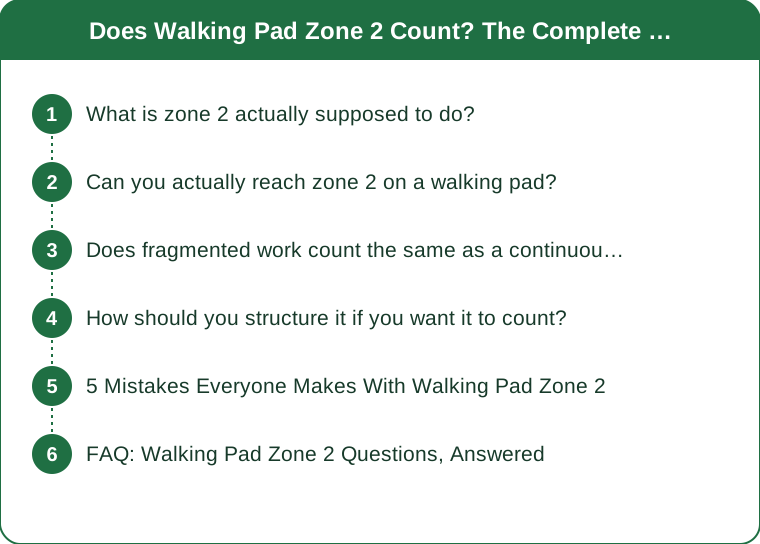
What is zone 2 actually supposed to do?
It is worth being precise, because most of the confusion comes from a fuzzy definition.
Zone 2 is an intensity, defined physiologically rather than by heart rate. In a five-zone model it sits roughly at 60-70% of maximum heart rate, but the underlying definition is intensity at or just below the first ventilatory or lactate threshold — the point where blood lactate starts to rise above baseline. That is why lab testing gives a different and better answer than a formula.
The adaptations are largely peripheral. Increased mitochondrial density and function in the working muscle, improved capillarisation, improved fat oxidation at a given intensity, and improvements in the muscle’s capacity to clear lactate. These are muscle-level changes, driven substantially by time spent at the intensity.
Central adaptations happen too. Increased stroke volume and plasma volume, and improvements in cardiac efficiency — these come from sustained work at a heart rate high enough to load the heart, which is where the intensity floor matters.
And volume is the primary driver. The reason endurance athletes do enormous amounts of easy work is that these adaptations respond to accumulated time at intensity. This is the part that makes the walking pad question interesting, because a treadmill desk provides volume like nothing else in a normal life.
The critical point: for the peripheral adaptations, the muscle needs to be working at an intensity that actually challenges it. For a trained person, walking at 4 km/h does not — the local muscular demand is too low, whatever the heart rate says.
Can you actually reach zone 2 on a walking pad?
This depends almost entirely on your fitness, and the honest answer for most people is: partially.
Typing sets the speed ceiling. Realistic desk-walking speeds are 3-5 km/h. Above about 5 km/h typing accuracy degrades sharply for most people, and above 6 km/h the gait changes enough that focused work becomes impractical.
Three different situations follow.
If you are relatively deconditioned or new to exercise, walking at 4-5 km/h may genuinely put you in zone 2, and possibly above it. This is real training and the adaptations are real.
If you are moderately fit, desk speeds probably sit in zone 1 — active recovery territory. Valuable for health, blood glucose and recovery, but below the intensity that drives the classic zone 2 adaptations.
If you are well trained, walking at 5 km/h is barely above resting metabolism in relative terms and is not training in any meaningful sense. It is excellent for health and it is not zone 2.
Adding incline changes the maths substantially. This is the single most useful lever: 5% incline at 4.5 km/h raises the demand dramatically without touching typing accuracy much, and it moves many moderately fit people into genuine zone 2. If you want your desk walking to count as training, incline is how.
And your watch may be lying. Wrist-based optical heart rate is least accurate at low intensities, with typing motion adding artefact. A chest strap is worth having before you conclude anything about which zone you are in.
Does fragmented work count the same as a continuous session?
Partially, and the honest answer is that the research does not fully settle it.
For general health outcomes, accumulated activity looks very good. Physical activity guidelines moved away from requiring 10-minute bouts precisely because accumulated shorter bouts show meaningful benefits for cardiovascular risk, glucose control and mortality. From a health standpoint, three hours of desk walking is excellent and the fragmentation matters little.
For endurance performance adaptations, continuous work has advantages. Sustained sessions produce a prolonged physiological stimulus — sustained elevated stroke volume, sustained substrate demand, sustained thermal and cardiovascular load. Breaking that into ten-minute fragments separated by sitting reduces the depth of the stimulus even if the total minutes match.
Three practical consequences.
Longer blocks are better than scattered minutes. A continuous 60-minute block during a morning of writing beats six ten-minute walks between meetings, for training purposes.
But scattered minutes beat sitting comfortably. For glucose regulation in particular, breaking up sitting is specifically beneficial — arguably more so than the same minutes done in one block.
And they serve different goals. If your goal is health and metabolic function, fragmentation is fine and possibly preferable. If your goal is aerobic base for endurance performance, you still need dedicated continuous sessions, and the walking pad supplements rather than replaces them.

How should you structure it if you want it to count?
Five adjustments, from most to least impactful.
Use incline aggressively. 3-8% at 4-5 km/h is the single change that turns desk walking from movement into training for most people. Start at 3% and build; steep incline at low speed also loads the calves and glutes in a way flat walking does not.
Wear a chest strap for a week to find out where you actually are. Guessing your zone from a wrist reading during typing is guessing. One week of accurate data settles it, and you can go back to the watch afterwards knowing what its numbers mean for you.
Build one long continuous block into the day. Schedule your least meeting-heavy hour as a walking hour. Sixty unbroken minutes is worth more for aerobic adaptation than the same minutes scattered.
Keep dedicated training separate. If you have endurance goals, your zone 2 sessions on a bike or running are the training. The desk walking is base volume on top, and treating it as a replacement is how people plateau.
And progress it like training if you want training results. Same speed and incline every day for six months produces adaptation and then stops. Add incline, add speed, or add duration every few weeks — the walking pad is subject to the same progressive overload principle as everything else.
5 Mistakes Everyone Makes With Walking Pad Zone 2
Trusting the wrist heart rate while typing. Optical sensors are least accurate at low intensity, and hand and forearm movement adds artefact. This is the number most walking pad zone 2 claims rest on, and it is the least reliable one.
Assuming step count equals training. 15,000 steps at desk pace is genuinely good for health and is not the same stimulus as 45 minutes at threshold-adjacent intensity. Both are worth having; they are not interchangeable.
Never touching the incline. The single biggest lever available, ignored by most users because the pad came flat and stayed flat.
Replacing real training with it. For anyone with endurance goals, desk walking is additional volume, not a substitute for structured sessions. The people who plateau are the ones who made the swap.
And ignoring the load management side. Three hours a day of walking is a real volume increase for feet, calves and hips, and going from zero to three hours in a week produces exactly the overuse problems you would expect. Build up by about 30 minutes a week. This is general information, not medical advice — new or persistent pain in the feet, shins or hips deserves proper assessment rather than more walking.
FAQ: Walking Pad Zone 2 Questions, Answered
Is walking pad time real cardio?
For general health, unambiguously yes. Whether it is zone 2 training depends on your fitness — for many moderately fit people, desk speeds sit in zone 1.
How do I make it count as zone 2?
Add incline. 3-8% at 4-5 km/h moves most people into genuine zone 2 without wrecking typing accuracy.
Is my watch accurate for this?
Less than you would like. Optical wrist sensors struggle most at low intensity, and typing adds motion artefact. Use a chest strap to calibrate.
Does fragmented walking work?
For health outcomes, yes — and breaking up sitting has specific metabolic benefits. For endurance adaptation, continuous blocks are better.
Can it replace my zone 2 runs or rides?
Not if you have performance goals. Treat it as base volume on top of structured training.
How much is enough?
More is generally better for health, within reason. Build up gradually — 30 minutes a week of added duration is a sensible ramp.
Will I get fitter just from desk walking?
If you are currently sedentary, quite possibly a lot. If you already train, it improves health and recovery more than it improves fitness.
What speed should I aim for?
Whatever you can sustain while working — usually 4-5 km/h — and then use incline to control intensity rather than speed.
TL;DR:
- Zone 2 is an intensity, not a speed. Desk walking reaches it for some people and sits in zone 1 for many.
- Incline is the lever: 3-8% at 4-5 km/h turns desk walking into genuine training without hurting typing.
- Wrist heart rate is unreliable at low intensity — calibrate with a chest strap for a week.
- Fragmented walking is excellent for health; continuous blocks are better for aerobic adaptation.
- If you have endurance goals, this is base volume on top of training, not a replacement — and build up by ~30 min/week to avoid overuse.
Set the incline to 3% tomorrow and watch what your heart rate does. That number answers the whole question for you personally.
Keep Reading
This article is for general informational purposes only and is not medical advice. Always consult a qualified health professional for guidance specific to you.