Zone 2 After a Bad Night: Train, Adjust, or Skip?
Quick Answer: One bad night does not require skipping zone 2, and it does require adjusting. Poor sleep raises resting and submaximal heart rate, which means your usual pace now sits above zone 2 even though the effort feels similar. Go by heart rate or by breathing rather than by pace, expect to move noticeably slower, and shorten the session if the drift keeps climbing. Skip it only after several consecutive bad nights or if you are ill, since chronic sleep loss and training stress compound.

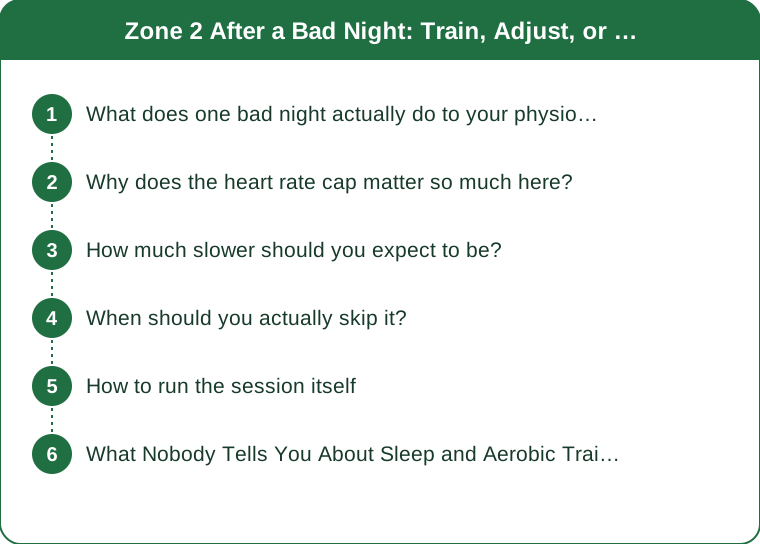
What does one bad night actually do to your physiology?
More than most people expect at low intensity, and less than they fear at high intensity.
Sympathetic nervous system activity rises. Sleep deprivation shifts autonomic balance toward sympathetic dominance, which raises heart rate at rest and at any given workload.
Resting heart rate typically climbs by five to ten beats per minute after a substantially short night, and heart rate variability drops, which is the more sensitive marker of the two.
Submaximal heart rate rises proportionally. The pace that used to sit at 135 beats now sits at 145, which means running it puts you above zone 2 rather than in it.
Perceived exertion rises at the same workload. Everything feels harder, which is a real perceptual effect and not a motivation problem.
Thermoregulation is slightly impaired, so you heat up faster and heart rate drifts more within a session.
Glucose handling and glycogen storage are both affected after even a single night of restriction, which matters more for long sessions than short ones.
And maximal performance is surprisingly preserved. Short maximal efforts hold up reasonably well after one bad night. It is submaximal endurance work — precisely what zone 2 is — that is most affected, which is exactly counter to most people’s intuition.
Why does the heart rate cap matter so much here?
Because zone 2’s entire value depends on staying below a physiological threshold, and that threshold has not moved even though your heart rate has.
Zone 2 targets a specific metabolic state: predominantly aerobic, largely fat-fuelled, below the first ventilatory threshold, at a lactate level that stays roughly steady rather than accumulating.
The adaptations are mitochondrial and capillary. Density and function improve with high volumes of time in that state, and the volume matters more than the intensity.
Exceeding the ceiling changes the stimulus. Drift up into zone 3 and you are doing a moderate session that is harder to recover from and produces less of the specific adaptation you wanted.
That grey zone is the classic error even on a good day, and poor sleep makes it far more likely, because your usual pace now produces a higher heart rate.
Which is why pace is the wrong guide on these days. The number on the watch that normally corresponds to zone 2 is now a zone 3 effort.
Heart rate is more reliable but not perfect, because sleep deprivation shifts the whole curve and can also produce cardiac drift within a session.
The most robust guide is breathing. If you can hold a full conversation, or nasal breathe comfortably, you are in the right place regardless of what the pace or the watch says. That relationship does not change with sleep.
How much slower should you expect to be?
Considerably, and the amount is informative in itself.
A pace drop of thirty to sixty seconds per kilometre is common after one substantially short night, to hold the same heart rate.
Some people see more. Individual variation in sleep sensitivity is large, and there is no useful average to compare yourself against.
The pace drop is not a sign of lost fitness. It is a temporary shift in the heart rate to workload relationship, and it usually resolves within one or two good nights.
It matters that you accept it. Trying to hold your usual pace at a higher heart rate is the single most common mistake on these days, and it converts an easy session into a moderate one.
Cardiac drift will be larger than usual. Heart rate climbing steadily through a session at constant pace is normal; after poor sleep it climbs faster and further, which is a reason to plan a shorter session.
And the drift is your stopping signal. If you are having to slow repeatedly to hold the same heart rate and it keeps climbing anyway, the session has stopped being productive.
One useful habit: log the pace at your usual zone 2 heart rate every session. Over weeks it becomes a genuinely sensitive readiness metric, and it costs nothing beyond writing down a number you already have.

When should you actually skip it?
Less often than the internet suggests for one bad night, and more often than most people do for a bad week.
One bad night: train, adjusted. Reduce the duration by twenty to thirty percent, go by breathing, accept the slower pace. Easy aerobic work after poor sleep is generally well tolerated and often improves mood and subsequent sleep.
Two or three consecutive bad nights: reduce further. Half the usual duration, strictly conversational, and consider walking or easy cycling instead of running to reduce mechanical load.
A week or more of restricted sleep: restructure the week. This is the point at which training stress and sleep debt compound meaningfully, and where injury and illness risk rises. Fewer, shorter sessions is the correct response.
Any illness symptoms: skip. Sore throat, fever, chest symptoms, or general malaise are a different category entirely, and the usual guidance is to avoid training with symptoms below the neck or with any fever.
Resting heart rate more than about ten beats above baseline for several days is worth taking seriously as a signal, particularly alongside a suppressed heart rate variability trend.
And a session you dread is a data point. Motivation collapse is a reasonably sensitive early marker of accumulated stress, and it is worth listening to rather than overriding on repeat.
One thing worth saying plainly: intensity is what compounds badly with sleep debt, not volume at low intensity. If something has to go from a sleep-deprived week, cut the intervals and keep some of the easy aerobic work. This is general information, not medical advice, and persistent unexplained fatigue is worth discussing with a doctor.
How to run the session itself
Seven adjustments that make a poor-sleep zone 2 session productive rather than counterproductive.
Check resting heart rate before getting up. It takes ten seconds and it tells you how much adjustment the day needs. A rise of five to ten beats means a meaningfully adjusted session; more than that means a substantially reduced one.
Extend the warmup. Ten to fifteen minutes of very easy movement before settling into the target effort, rather than the usual five. Everything takes longer to come online on a bad night.
Set the watch to heart rate, not pace. Better still, cover the pace field entirely for the session so you are not tempted to chase it.
Use the talk test as the primary control. Full sentences, comfortably. If you have to breathe mid-sentence, slow down regardless of what the numbers say.
Reduce the planned duration by twenty to thirty percent before you start, rather than deciding mid-session. Pre-committing to a shorter session removes the negotiation.
Take walk breaks without guilt if running keeps drifting the heart rate up. Walking at zone 2 heart rate is still zone 2 training.
And eat and drink slightly more attentively. Glucose handling is impaired after short sleep and appetite regulation is disrupted, so having a plan for fuelling beats improvising.
One note on timing: if you can move the session later in the day after a bad night, do. Core temperature, reaction time and perceived exertion all improve through the morning, and a session at four in the afternoon after five hours of sleep is meaningfully better than the same session at six in the morning.
What Nobody Tells You About Sleep and Aerobic Training
Easy aerobic exercise usually improves the following night’s sleep, which makes an adjusted zone 2 session one of the better responses to a bad night rather than something to avoid. Hard intervals, particularly late in the day, tend to do the opposite.
Sleep debt does not average out neatly. Five hours on four nights followed by ten hours on the fifth does not restore the position, and the training stress accumulated across those four days is real.
Heart rate variability is more sensitive than resting heart rate, and considerably noisier. A single low reading means very little; a downward trend across four or five days means a lot.
The perceived exertion shift is the most useful signal you have and the one people trust least, because it feels subjective. It tracks physiological readiness surprisingly well.
Zone 2 done properly is the most sleep-robust training you can do. It is low mechanical stress, low metabolic stress, and largely aerobic, which is why the answer to a bad night is usually to adjust it rather than to replace it with something else.
And chronic under-sleeping caps aerobic progress regardless of how well you train. Mitochondrial adaptation, glycogen resynthesis and immune function all depend on sleep, so a training block built on six hours a night will under-deliver whatever the sessions look like.
One last practical point: many people who consistently see elevated morning heart rate and poor sleep quality alongside heavy training are simply under-fuelling. It is worth ruling out before assuming the training load is the problem.
TL;DR:
- One bad night raises submaximal heart rate, so your usual pace is now above zone 2.
- Go by breathing and heart rate, never pace, and expect thirty to sixty seconds per kilometre slower.
- Cut the planned duration by twenty to thirty percent before you start, not mid-session.
- Skip for illness or after several consecutive bad nights; cut intensity before you cut easy volume.
Easy aerobic work is the most sleep-robust training there is. Adjust it rather than abandoning it.
Keep Reading
This article is for general informational purposes only and is not medical advice. Always consult a qualified health professional for guidance specific to you.