Why Your Zone 2 Heart Rate Runs Higher at Elevation — and How to Adjust
Quick Answer: Lower oxygen availability at altitude forces your heart rate up at the same relative effort, which means a heart rate that reliably kept you in zone 2 at sea level can push you into zone 3 within the first mile at elevation. The fix is recalibrating your zone 2 ceiling for the specific altitude you’re training at, not assuming your sea-level numbers still apply.
You’ve trained zone 2 for months, know your ceiling number cold, and land somewhere above 5,000 feet only to find that same easy, conversational pace has your heart rate reading 15-20 beats higher than it should. It’s not a fitness setback — it’s physiology doing exactly what it’s supposed to do.

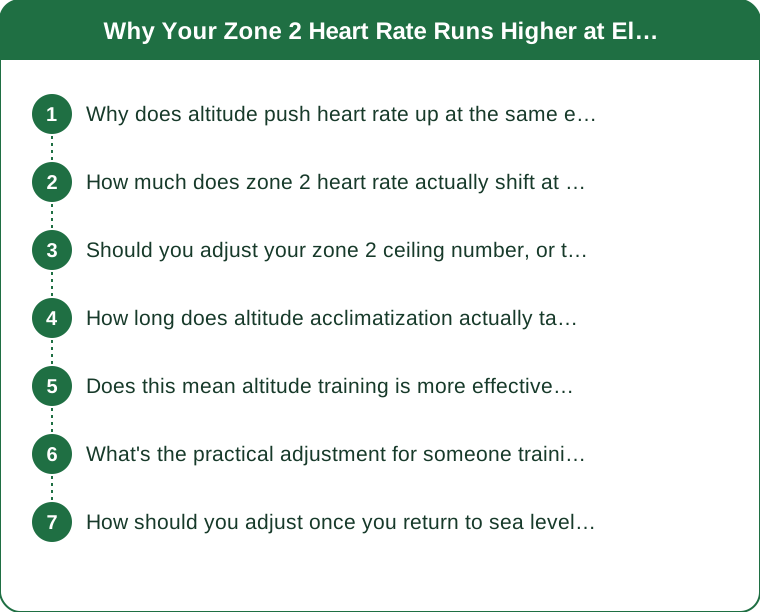
Why does altitude push heart rate up at the same effort level?
Reduced atmospheric oxygen at elevation means each breath delivers less oxygen to working muscles, so your body compensates by increasing heart rate and breathing rate to move more blood and air per minute, extracting enough oxygen from a thinner supply. This is a genuine physiological response, not a sign your cardiovascular fitness has declined.
The effect starts becoming noticeable above roughly 5,000-6,000 feet for most people, and grows more pronounced the higher you go.
How much does zone 2 heart rate actually shift at altitude?
Expect roughly 10-20 additional beats per minute at the same perceived effort, though this varies by individual acclimatization status and the specific elevation. Someone freshly arrived at 8,000 feet will see a larger shift than someone who’s spent a week acclimatizing at that altitude already.
This is why using a fixed heart rate number as your zone 2 ceiling, without adjusting for elevation, routinely pushes altitude training sessions into zone 3 without the athlete realizing it.
Should you adjust your zone 2 ceiling number, or trust perceived effort instead?
For the first several days at a new altitude, perceived effort (the talk test) is more reliable than your usual heart rate number. If you can hold a full conversation in complete sentences without gasping, you’re in zone 2 territory regardless of what the number says — even if that number is meaningfully higher than your sea-level ceiling.
Once you’ve acclimatized over 5-7 days, you can start trusting a recalibrated heart rate number again, adjusted upward from your sea-level ceiling based on what the talk test has been telling you.

How long does altitude acclimatization actually take for this to normalize?
Partial acclimatization typically develops over 5-7 days, with the heart rate premium at a given effort level gradually shrinking as your body increases red blood cell production and improves oxygen extraction efficiency. Full acclimatization for people not native to altitude can take several weeks, and some of the heart rate elevation persists even after that adjustment period, just less dramatically.
Does this mean altitude training is more effective for zone 2 adaptations?
Not necessarily more effective for zone 2 specifically — the cardiovascular benefit of true zone 2 work comes from time spent in that aerobic range, not from the absolute heart rate number. Training at altitude does offer other adaptations (increased red blood cell mass, improved oxygen efficiency) that carry over to sea-level performance, but that’s a separate benefit from the zone 2 training stimulus itself.
What’s the practical adjustment for someone training zone 2 on a trip to altitude?
Use the talk test as your primary guide for the first week, treat your heart rate number as unreliable during that window, and expect your usual pace to feel harder for the same output. Don’t chase your sea-level heart rate ceiling by slowing down further than the talk test suggests is necessary — that often means moving slower than your body actually needs to stay aerobic.
How should you adjust once you return to sea level after altitude training?
Expect your zone 2 heart rate ceiling to temporarily read slightly lower than before the trip, as your body’s improved oxygen efficiency from altitude exposure carries over for one to several weeks. This is a genuine, if temporary, fitness benefit — use the talk test again for the first few sessions back to confirm your numbers before fully trusting the adjusted ceiling.
TL;DR:
- Reduced oxygen at altitude raises heart rate 10-20 bpm at the same effort — not a fitness setback
- Use the talk test as your primary zone 2 guide for the first 5-7 days at a new elevation
- Full acclimatization can take several weeks, with some heart rate elevation persisting longer
- Altitude’s real benefit is oxygen-efficiency adaptation, not a more effective zone 2 stimulus itself
- Expect a temporarily lower zone 2 ceiling for one to several weeks after returning to sea level
The elevated heart rate at altitude is your body working correctly under harder conditions — recalibrate the number, not your training plan.
Keep Reading
This article is for general informational purposes only and is not medical advice. Always consult a qualified health professional for guidance specific to you.