Zone 2 on Hills: The Complete Guide to Uphill Aerobic Training
Quick Answer: Uphill hiking is excellent for zone 2 because it produces a high aerobic load at low impact and low speed — but the gradient, not you, controls the intensity, so most people drift above zone 2 without noticing. Manage intensity with cadence and step height rather than with effort, use the talk test rather than trusting pace, and accept that on steep sections the honest zone 2 choice is often to slow down to a speed that feels almost absurd.
You went for a hike, kept it comfortable, and got home to find your heart rate spent two hours in zone 3. This is the single most common training-log complaint among people who hike.
Uphill terrain removes your ability to self-regulate in the way flat ground allows, and this guide covers how to get it back — how zone 2 actually works on hills, what to monitor, how to structure a session, and where hiking beats running for aerobic development.

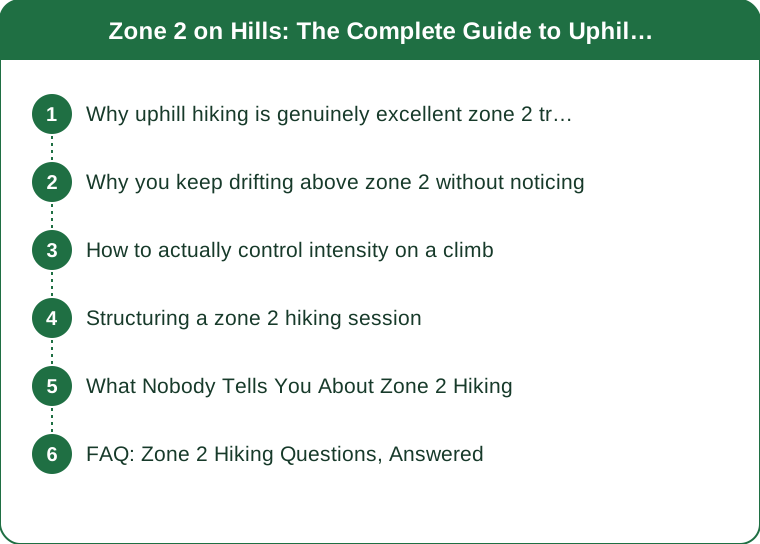
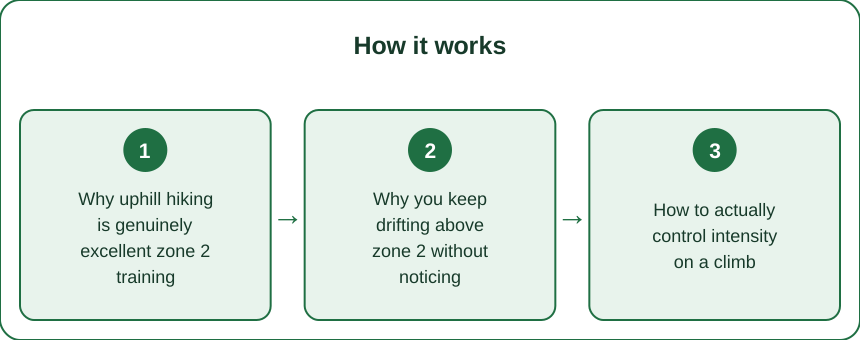
Why uphill hiking is genuinely excellent zone 2 training
There is a reason mountain athletes and endurance coaches keep coming back to it.
High aerobic demand at low mechanical impact. Walking uphill produces substantial cardiovascular work with far lower ground reaction forces than running. You can accumulate a large volume of aerobic time without the impact load that limits running volume, which matters enormously for anyone building a base, returning from injury, or carrying more body weight.
Sustained, uninterrupted effort. Flat zone 2 running is deceptively hard to execute — you speed up on the descents, you stop at road crossings, and your effort fluctuates. A steady climb produces continuous, unbroken aerobic work, which is exactly what zone 2 adaptations respond to.
Excellent for the specific adaptations zone 2 targets. The commonly cited benefits — mitochondrial density, capillary development, and improved fat oxidation — respond to duration at a controlled intensity. Uphill hiking makes long-duration controlled intensity easy to sustain, because the low speed and interesting environment make two hours pass far more comfortably than two hours on a treadmill.
Strength as a bonus. Uphill walking loads the glutes, quads, and calves meaningfully more than flat walking. You get a genuine muscular stimulus alongside the aerobic one, particularly with a light pack.
Low skill requirement and highly accessible. No technique to learn, no equipment beyond footwear, and it works for a very wide range of fitness levels — the gradient scales the difficulty automatically.
And it is enjoyable, which is not a trivial factor. Zone 2 requires volume, volume requires adherence, and adherence follows enjoyment. A person who hikes for two hours weekly will out-accumulate a person who intends to do 90-minute treadmill sessions and does one.
Why you keep drifting above zone 2 without noticing
Four mechanisms, and understanding them is most of the solution.
The gradient sets the intensity, not you. On flat ground, if the effort rises you slow down and it comes back. On a climb, slowing down has a floor — below a certain speed you are barely moving, and the effort of lifting your body against gravity per step does not fall much. When the trail steepens, your intensity rises whether you consent or not.
Step height is the hidden variable. A big step up onto a rock is a single-leg squat with your body weight. A series of large steps is effectively interval training, and it happens without any change in your perceived pace. This is why technical trails produce far higher heart rates than smooth ones at the same gradient.
Cardiac drift. Over a long session, heart rate rises at constant workload — driven by heat, dehydration, and fatigue. A hike that starts at the top of zone 2 will be in zone 3 by hour two, even on identical terrain. This is normal physiology, and it means the correct starting intensity is lower than the ceiling.
Heat and altitude both shift everything upward. Heart rate at a given workload rises in heat as blood is diverted to the skin, and altitude raises it further. A hike at 2,500 m in warm conditions can put you in zone 3 at an effort that would be comfortable zone 2 at home.
Add the psychological factor: hikes have destinations. A summit, a viewpoint, a group waiting at the top — all of them pull effort upward, and the last 20 minutes of a climb are almost always the hardest part of anyone’s day. Knowing this in advance is what lets you plan around it.
How to actually control intensity on a climb
Five levers, in order of usefulness.
1. Cadence — the primary control. Take shorter, quicker steps rather than longer, slower ones. Shorter steps mean less vertical gain per step, which means lower peak force and lower intensity per step. This is the single most effective intensity control available on a climb and most people never touch it, instead trying to walk slowly with the same long stride.
2. Route choice around step height. Look for the line with the smallest steps. On a rocky trail, the difference between the easiest and hardest line up the same section can be a full heart rate zone. Zigzag on steep sections rather than going straight up — this is why switchbacks exist.
3. Poles. Trekking poles distribute some of the work to the upper body and reduce leg load, and for many hikers they measurably lower heart rate at a given pace on climbs. They also help enormously on descent, which is where the muscle damage happens.
4. Deliberate micro-pacing on gradient changes. Pre-emptively slow down when you see the trail steepen, rather than reacting when your heart rate has already spiked. Anticipation beats correction, because heart rate lags workload by 30 to 60 seconds.
5. Short strategic pauses — used correctly. Ten to twenty seconds at the top of a steep pitch, before your heart rate climbs, keeps a session in zone. This is not cheating; it is interval management. Standing still for two minutes because you are already blown is a worse version of the same tool.
And the check that matters more than any device: the talk test. In zone 2 you should be able to speak in full sentences with mild effort. If you are speaking in three-word fragments, you are above it. On a climb this is more reliable than heart rate, which drifts, and far more reliable than pace, which means nothing on a gradient.

Structuring a zone 2 hiking session
How to build a session that actually accumulates the intended stimulus.
Duration is the goal, not distance. Zone 2 adaptations respond to time at intensity. A four-mile hike with 800 m of gain is a bigger aerobic session than an eight-mile flat walk. Plan in hours, not miles.
Target 60 to 120 minutes for a productive session, and considerably longer is fine — long zone 2 is one of the few types of training where more is generally better, provided the intensity stays honest.
Structure it as: 10 to 15 minutes easy build, the main climb at controlled effort, then a deliberately managed descent.
Start slower than you want to. Because of cardiac drift, the first 20 minutes should feel almost too easy. If you start at the top of your zone, you will finish above it. This is the discipline that separates a genuine zone 2 session from a moderate-hard one.
Manage the descent deliberately. Descending is where the eccentric muscle damage happens, and it is not aerobically useful. Descend at a controlled pace, use poles, and take shorter steps — hammering downhill costs you two days of recovery for zero aerobic benefit.
Fuel and drink like it is a long session, because it is. Two hours of uphill work is a substantial energy expenditure. Take carbohydrate and fluid on anything over 90 minutes, and more in the heat.
How often: for most people, one to three zone 2 sessions weekly, with hiking able to fill one or all of them. A common structure is a majority of weekly aerobic volume at zone 2 with a small proportion at higher intensity — the widely discussed polarized approach — and hiking is an excellent way to build the large easy portion without accumulating running impact.
A light pack is a legitimate progression. Adding 5 to 10 percent of body weight increases the aerobic demand at the same gradient. Ramp it gradually — pack weight is a load increase like any other.
What Nobody Tells You About Zone 2 Hiking
Your zone 2 heart rate on hills may legitimately differ from your running zones. Heart rate zones derived from a running test do not transfer perfectly to hiking, particularly with poles or a pack. If you use hiking as a primary aerobic tool, it is worth establishing your zones in that modality rather than importing numbers from a treadmill test.
Wrist-based heart rate is less reliable when you are gripping poles, and cold weather worsens optical sensor accuracy. A chest strap is meaningfully more accurate for hill work, and if you are training by heart rate at all, accuracy is the whole point.
Downhill soreness is not a fitness signal. The two-day soreness after a big descent comes from eccentric loading, not from aerobic intensity. You can have a perfect zone 2 climb and still be wrecked on Tuesday from the way you came down.
Altitude changes your zones, not just your comfort. At elevation, heart rate at a given workload rises and your maximum typically falls slightly. Your zone 2 pace at 3,000 m will be far slower than at sea level and that is correct, not a fitness regression.
Terrain interest is a genuine training asset. The primary failure mode of zone 2 is boredom-driven non-compliance — either skipping sessions or unconsciously speeding up to make them interesting. A trail solves both problems, which is worth more than most training optimizations.
And the hardest part is social. Hiking with someone fitter than you is not a zone 2 session, it is a tempo session with a view. If zone 2 is the goal, either hike alone, hike with someone matched, or agree in advance that you are setting the pace. This is the most common reason people’s intended easy days are not easy.
FAQ: Zone 2 Hiking Questions, Answered
Should I use heart rate or the talk test on hills?
Use both, and trust the talk test when they disagree. Heart rate drifts upward over a long session, is affected by heat, altitude, caffeine, and sleep, and lags behind changes in workload by up to a minute. The talk test — full sentences with mild effort — reflects your current metabolic state directly. On a climb, where conditions change constantly, it is the more practical instrument.
Is hiking uphill as effective as running for zone 2 adaptations?
For aerobic base development, time at the right intensity is the primary driver, and hiking accumulates it well at a fraction of the impact cost. Running is more specific if your goal is running performance, and it produces the running-specific adaptations hiking cannot. For general aerobic fitness, metabolic health, and base building, uphill hiking is genuinely excellent — and for many people it is the version they will actually do consistently.
How steep should the terrain be?
A sustained moderate gradient — roughly 8 to 15 percent — is ideal for zone 2 hiking, because it produces good aerobic load while still allowing you to control intensity through cadence. Much steeper than that and even a very slow pace pushes you into zone 3, which is fine as a training choice but is no longer zone 2. If your local terrain is steeper, use switchbacks, shorten your steps aggressively, and accept a walking pace that feels almost comically slow.
TL;DR:
- Uphill hiking delivers high aerobic load at low impact, sustained and uninterrupted — near-ideal zone 2 conditions.
- The gradient sets your intensity, so drift above zone 2 happens without any change in perceived effort.
- Control intensity with cadence first: shorter, quicker steps, not longer slower ones.
- Route choice around step height, poles, and pre-emptive slowing before gradient changes all help substantially.
- Trust the talk test over heart rate on hills; heart rate drifts with heat, altitude, and duration.
- Plan sessions in hours rather than miles, start deliberately too easy, and manage the descent to protect recovery.
The thing that makes uphill hiking such a good aerobic tool is also what makes it hard to execute: the terrain is doing the programming. Once you take that job back — with cadence, with route choice, and with the discipline to start slower than feels reasonable — you end up with the rare training session that builds a genuine aerobic base and that you actually look forward to.
Keep Reading
This article is for general informational purposes only and is not medical advice. Always consult a qualified health professional for guidance specific to you.