How Much Zone 2 Do You Actually Need Per Week (and How Should You Split It)?
Quick Answer: The practical minimum for meaningful aerobic adaptation is about 150 minutes per week of zone 2, split across three sessions. The commonly cited sweet spot for people training seriously is 180-240 minutes across 3-4 sessions, with individual sessions of at least 45 minutes - session duration matters more than weekly total once you are above the minimum.
Everybody agrees zone 2 is important. Nobody agrees on how much.
You will find recommendations from 90 minutes a week to twelve hours, often quoted with equal confidence, and usually without saying who they are for.
The honest answer depends on what you are training for and how much total training you do. Here is the complete version, with numbers you can actually apply.

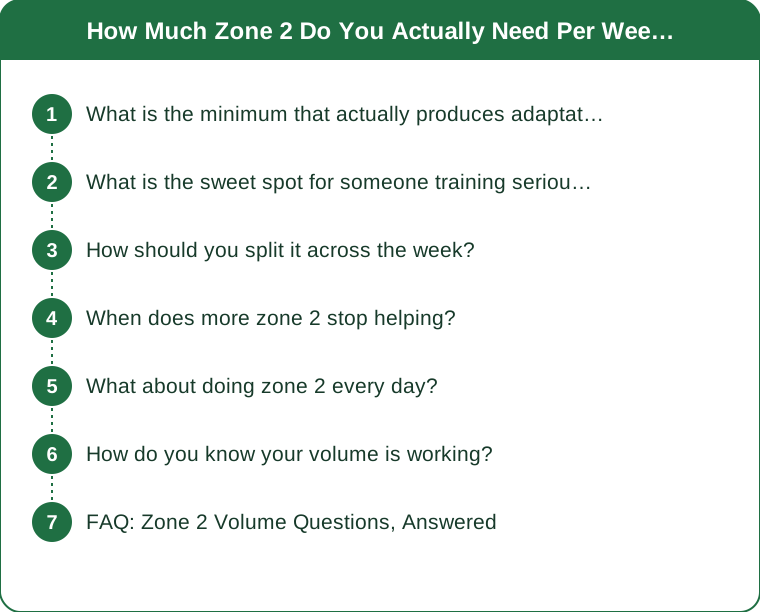
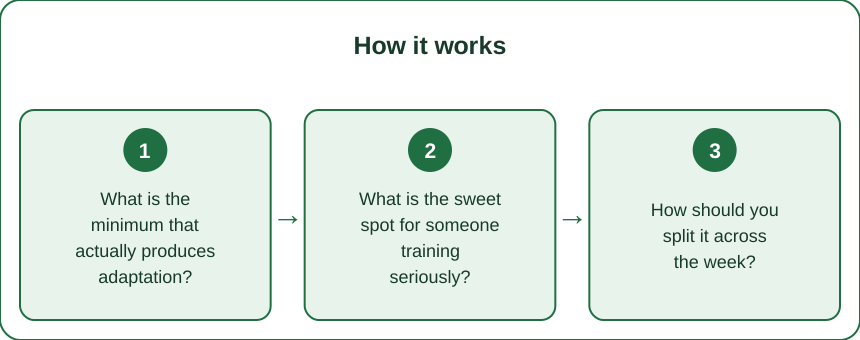
What is the minimum that actually produces adaptation?
The adaptations zone 2 is prized for - mitochondrial density, capillary development, improved fat oxidation, increased stroke volume - respond to accumulated time at a sustained submaximal intensity. They are duration-driven rather than intensity-driven, which is the whole reason the zone exists as a training concept.
General physical activity guidelines land at 150 minutes of moderate activity per week, and that is a reasonable floor for aerobic health. For training adaptation specifically, most coaches use a similar number as the entry point: 150 minutes per week, across at least three sessions.
Below about 40 minutes total per session, the picture changes. Short zone 2 sessions are not useless - they contribute to weekly volume and they are better than nothing - but the mechanisms benefit disproportionately from sustained time. The metabolic environment that drives adaptation takes time to establish, which is why a single 60-minute session generally outperforms two 30-minute ones despite identical total time.
So the practical minimum has two parts: 150 minutes weekly, with individual sessions of at least 45 minutes. Three sessions of 50 minutes meets both. Six sessions of 25 minutes meets one and misses the other.
If your schedule genuinely only allows short sessions, they still count and you should still do them. Just know that the same total volume in fewer, longer blocks would be doing more.
What is the sweet spot for someone training seriously?
For recreational athletes with a goal - a race, a measurable fitness target, general performance - 180-240 minutes per week across 3-4 sessions is where most of the available benefit sits relative to the time cost.
A typical structure at that volume:
- Two sessions of 60 minutes on weekdays
- One session of 90-120 minutes on a weekend
- Optionally, one more 45-60 minute session
That lands between 3 and 4 hours weekly, which is achievable alongside a job, and it is enough to produce genuine aerobic development over a training block of 8-12 weeks.
The often-cited polarized training model - where roughly 80% of training volume sits at low intensity and 20% at high - is where the modern emphasis on zone 2 comes from. Applied to a 5-hour weekly training load, that means about 4 hours easy and 1 hour hard.
The important framing: the 80/20 split is a ratio, not a volume prescription. If you train 4 hours a week, 80% is 3.2 hours. If you train 15 hours, it is 12. People sometimes read the elite endurance literature - where athletes accumulate 15-25 hours a week - and conclude they need similar absolute volumes. They do not. They need a similar distribution across whatever volume they actually do.
How should you split it across the week?
Three principles, in order of importance.
1. Longer sessions beat more sessions, once you are above three per week. Given a choice between four 45-minute sessions and three 60-minute ones, take the three longer ones.
2. Separate zone 2 from hard sessions where possible. Zone 2 done the day after a hard interval session is frequently not zone 2 at all - residual fatigue drives heart rate up at the same effort, and you end up in zone 3, which is the training-intensity equivalent of no-man’s land. If you must stack them, put the zone 2 before the hard session or leave 24 hours.
3. Protect one long session. The weekly long session is where a disproportionate share of the adaptation happens, and it is the first thing to get cut when the week gets busy. Schedule it first.
A workable weekly template for someone training 5 hours total:
- Monday: rest or 30 min easy
- Tuesday: intervals, 45 min
- Wednesday: zone 2, 60 min
- Thursday: zone 2, 60 min
- Friday: rest
- Saturday: zone 2 long, 100 min
- Sunday: zone 2, 45 min or rest
That is roughly 4 hours easy and 45 minutes hard - close to the 80/20 ratio without needing a spreadsheet.

When does more zone 2 stop helping?
There is a point of diminishing returns, and it arrives earlier for people with less training history and less recovery capacity.
The limiting factors are rarely aerobic. They are:
Total recovery capacity. Zone 2 is low-stress per minute but not zero-stress. At high volumes it accumulates, particularly in weight-bearing activities. A 10-hour weekly running load is a lot of impact regardless of intensity.
Time cost against other adaptations. Hours spent on zone 2 are hours not spent on strength work, which matters more for most people’s overall health and performance than the marginal zone 2 hour does.
Life. The volume you can sustain for six months beats the volume you can sustain for three weeks, every time.
A practical ceiling for most people training recreationally is around 5-6 hours of zone 2 weekly. Beyond that, returns get thin unless you are training for a long endurance event, and the injury and burnout risk climbs.
The signals that you have gone past your ceiling: resting heart rate drifting up over a week or more, sleep quality declining, motivation dropping, and zone 2 pace getting slower rather than faster at the same heart rate. That last one is the clearest - zone 2 pace at a given heart rate should improve over a training block. If it is going backwards, you are accumulating fatigue rather than fitness.
What about doing zone 2 every day?
It works for some people and is a common structure in high-volume endurance sports, but it requires two things most recreational athletes do not have.
First, genuinely easy easy days. Daily zone 2 only works if the sessions are actually low intensity. The most common failure is drifting to zone 3 on the days you feel good, which turns a sustainable structure into cumulative fatigue within a month.
Second, low-impact modality variety. Daily running is a high injury risk regardless of intensity. Daily zone 2 split across cycling, rowing, swimming, and walking is a much more sustainable proposition than five runs a week.
If you want to train most days, a good structure is:
- 3 sessions in your primary sport
- 2-3 sessions cross-training in something non-impact
- 1 full rest day minimum, non-negotiable
The rest day is not a compromise. Adaptation happens during recovery, and a week without one is a week where the training you did is only partly converted.
One genuinely useful addition at any volume: walking counts. For many people a brisk 45-minute walk sits in zone 2, and it adds volume with almost no recovery cost. It is the most underrated aerobic tool available.
How do you know your volume is working?
Four measures, in order of usefulness:
Pace or power at a fixed heart rate. The core metric. Run or ride the same route at the same heart rate every four weeks and compare. Improvement here is the direct evidence that aerobic adaptation is happening.
Heart rate at a fixed pace. The same measurement from the other direction, and easier on a treadmill or trainer where pace is controlled.
Cardiac drift within a session. The degree to which heart rate climbs during a steady effort. Less drift over a 60-minute steady session generally indicates better aerobic fitness. Note that heat inflates this substantially, so compare like conditions only.
Recovery between sessions. Subjective but real. Better aerobic fitness shows up as feeling ready sooner.
Give it 8-12 weeks before judging. Aerobic adaptations are slow - mitochondrial and capillary changes accumulate over months, not weeks - and the four-week check-ins are for direction, not verdicts.
This is general information, not medical advice. If you are new to structured exercise or have a cardiovascular condition, speak with a doctor before starting a training block.
FAQ: Zone 2 Volume Questions, Answered
Does zone 2 in different sports add together?
Yes, for cardiovascular adaptation. Cycling zone 2 and running zone 2 both build the same central adaptations. The peripheral, sport-specific adaptations are less transferable, which is why runners should do most of their volume running.
Can I split a long session into two on the same day?
It is better than not doing it, and slightly less effective than one continuous block. If a 90-minute session has to become 2 x 45, do it - consistency beats optimality.
What if I only have three hours a week total?
Then roughly 2.5 hours zone 2 and 30 minutes hard is a good split. At low total volumes, keeping the easy work genuinely easy matters even more, because you have no room to absorb accidental intensity.
Should zone 2 volume change through the year?
Yes for anyone with a goal event - base periods carry the highest zone 2 volume and the intensity share rises closer to competition. For general fitness, a steady year-round volume is simpler and works fine.
TL;DR:
- Practical minimum: 150 minutes per week across three sessions, with sessions of at least 45 minutes.
- Sweet spot for serious recreational training: 180-240 minutes across 3-4 sessions.
- 80/20 is a ratio, not a volume prescription - apply it to whatever total you actually train.
- Longer sessions beat more sessions, and one protected long session matters most.
- Separate zone 2 from hard days, or your zone 2 becomes zone 3.
- Ceiling for most recreational athletes is around 5-6 hours weekly; watch for pace at a given heart rate going backwards.
Zone 2 volume questions usually get answered with elite numbers applied to non-elite lives. Three sessions, 150-240 minutes, one of them long, kept genuinely easy - that produces the adaptation the whole approach is famous for, and it fits inside a normal week.
Keep Reading
This article is for general informational purposes only and is not medical advice. Always consult a qualified health professional for guidance specific to you.